British Library’s Shāhnāmah manuscript (Add.5600)
Date: late 15th century
Title: Shāhnāmah, by Firdawsī
Content : Firdawsī’s epic the Shāhnāmah ‘Book of kings’ with the older preface. Refurbished ca 1616 (f..274r) in the studio of ʻAbd al-Raḥīm Khān Khānān. Contains 90 overpainted mniatures by attributed Mughal artists.
Wednesday, June 22, 2016
Wednesday, June 8, 2016
Middle East Librarians Association
It is the purpose of the Middle East Librarians’ Association to facilitate communication among members through meetings and publications; to improve the quality of area librarianship through the development of standards for the profession and education of Middle East library specialists; to compile and disseminate information concerning Middle East libraries and collections and to represent the judgment of the members in matters affecting them; to encourage cooperation among members and Middle East libraries, especially in the acquisition of materials and the development of bibliographic control; to cooperate with other library and area organizations in projects of mutual concern and benefit; to promote research in and development of indexing and automated techniques as applied to Middle East materials.Anyone who is employed by an institution to service Middle East library materials in a professional capacity (selection, acquisition, cataloging, indexing, reference work, administration, and/or preparation of research tools), as well as any other person who has an interest in these aspects of Middle East library materials, is eligible for membership in our Association.
Friday, May 27, 2016
History of Serial Novels in Turkish Literature (1831-1928)
"The main aim of our Project which is supported by TÜBİTAK (The Scientific and Technological Research Council of Turkey) is to examine at least 150 newspaper and magazines that were published in Arabic based alphabet in the period 1831-1928, in order to find out and record the serial novels published in these periodicals. By the data that will be collected through the examination and scanning of the periodicals a database is going to be generated. Researchers can access this database from eResearch@ozyegin repository that is located under Ozyegin University Library from 1 January 2017 onwards. Database will provide opportunity to achieve information about the uploaded works on the basis of chronology, author, and periodical.The database will be available on 1 January 2017. eresearch.ozyegin.edu.tr/xmlui/
Another aim of the project is discovering novels and novelists that are not mentioned in literary histories or gone into oblivion in the pages of newspapers, and adding their names to the literary history. Discovery of new names and novels on the one hand enriches Turkish literature; on the other hand it also makes re-evaluation of Turkish novel history indispensible. Therefore when the project is finalized the history of Turkish literature up to 1928 would have the chance to be assessed with a new perspective including the sociological and political analysis."
Thursday, May 5, 2016
Open Access Journal: Turkish Studies: International Periodical For the Languages, Literature and History of Turkish or Turkic
[First posted in AMIR 6 January 2011, updated 5 May 2016]
Turkish Studies: International Periodical For the Languages, Literature and History of Turkish or Turkic
ISSN: 1308-2140
Turkish Studies: International Periodical For the Languages, Literature and History of Turkish or Turkic
ISSN: 1308-2140
Turkish Studies is a journal publishing academic , scientific and original articles based on research, analysis and assessment. Especially Turkish and English, German, French and Russian articles are published since Turkish Studies is published in the field of Social Sciences.Turkish studies , one of the most respected journals in the field of Turcology, is the meeting point for scientists. The most important feature of the journal is the system of guest editorial.Scientists leading their fields and achieved success can publish special issues on their professions thanks to the guest editorial system and as a result, reference guides belonging to the related fields are published.Thus, both scientists realize their dreams on their own fields and qualifed reference guides on their fields are published.Turkish Studies is in touch with great numbers of Turcology Institute all over the world. It has agencies in 30 countries from Norway to Canada.Turkish Studies is scanned by tens of indexes and databases. It was established by the efforts of many scientists connected to different universities.Therefore, Turkish Studies is non-aligned to any university or institution and it is maintaining its publishings independently.
Special Issue: Digital Humanities in Ancient Jewish, Christian and Arabic Traditions
Journal of Religion, Media and Digital Culture
ISSN: 2165-9214
ISSN: 2165-9214
Special Issue: Digital Humanities in Ancient Jewish, Christian and Arabic Traditions
Guest Editors: Claire Clivaz, Paul Dilley, David Hamidović, Mladen Popović, Caroline T. Schroeder and Joseph Verheyden
Table of Contents
Introduction
Claire Clivaz 1-20Articles
Caroline T. Schroeder 21-49
F. W. Dobbs-Allsopp, Chris Hooker, Gregory Murray 50-72
Jan Krans 73-88
James Allen Libby 89-135
David Allen Michelson 136-182
Jeanne-Nicole Mellon Saint-Laurent 183-204
Giuliano Lancioni, N. Peter Joosse 205-227
David Joseph Wrisley 228-257Book Reviews
Review of "Deconstructing Islamophobia in Poland", by Katarzyna Górak-Sosnowska (University of Warsaw, 2014)Ruth Tsuria 258-261
Review of "Religion in Science Fiction: The Evolution of an Idea and the Extinction of a Genre", by Steven Hrotic (Bloomsbury, 2014)Kristin Peterson 262-265
Review of "Preaching on Wax: The Phonograph and the Shaping of Modern African American Religion", by Lerone Martin (NYU, 2014)Denis Bekkering 266-270
Review of "Antagonism on YouTube: Metaphor in Online Discourse", by Stephen Pihlaja (Bloomsbury, 2014)Amber Michelle Stamper 271-274
Review of "Silver Screen Buddha: Buddhism in Asian and Western Films", by Sharon Suh (Bloomsbury, 2015)Giulia Evolvi 275-278
Wednesday, May 4, 2016
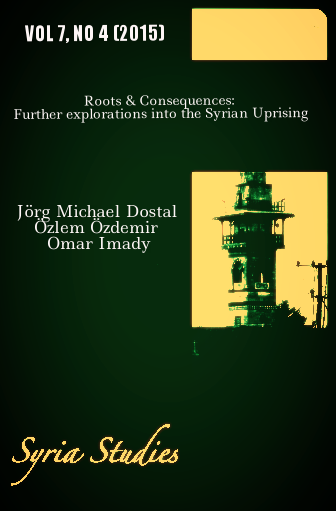
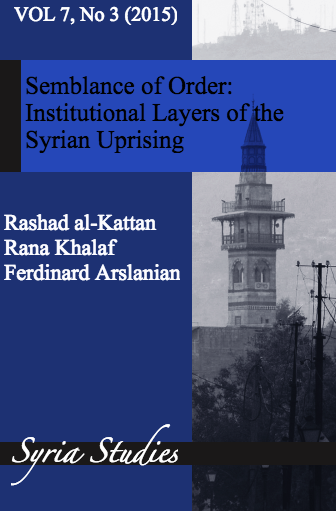
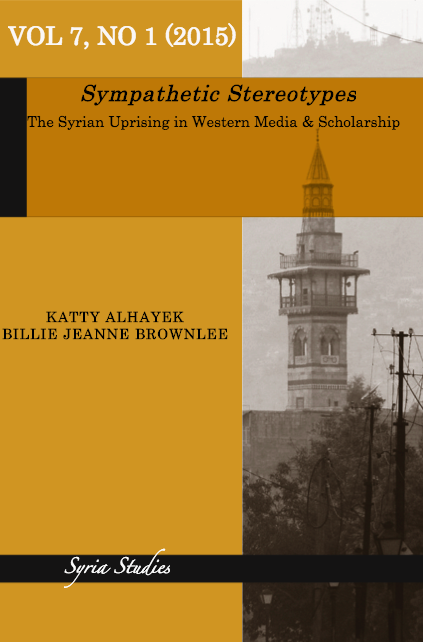
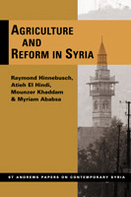
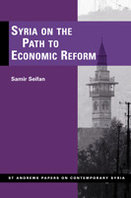
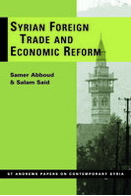
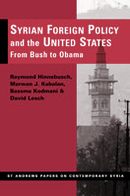
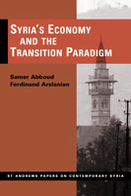
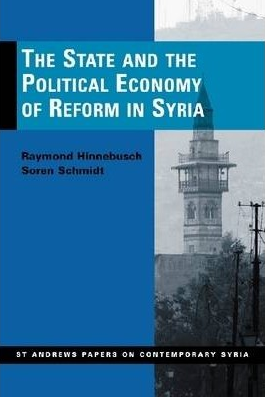
Open Access Journal: Syria Studies
Syria Studies
ISSN: 2056-3175
ISSN: 2056-3175
Welcome to Syria Studies, the official online journal of the Centre for Syrian Studies (CSS) at the University of St. Andrews. Syria Studiesis a peer reviewed and indexed journal that has previously been published in hard form. We are proud to include on our Board of Reviewers some of the most renowned authorities on Syria.
The aim of Syria Studies is to provide a space for scholars and students to publish work focused on the study of modern and contemporary Syria (history, politics, economy, & society). Given the interdisciplinary nature of Syria Studies, high-quality submissions from various academic and professional backgrounds are encouraged. -- Raymond Hinnebusch, Director of CSS
2015
2013
Vol 5, No 2 (2013): Syria During the Cold War
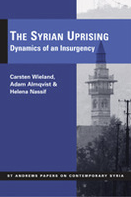
The full text of this volume is currently available in print only, from Lynne Reinner publishers at https://www.rienner.com/Vol 5, No 1 (2013): The Syrian Uprising
The full text of this volume is currently available in print only, from Lynne Reinner publishers at https://www.rienner.com/
2012
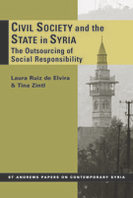
Vol 4, No 2 (2012): Civil Society and the State in Syria: The Outsourcing of Social Responsibility
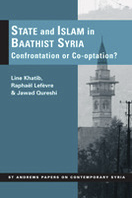
The full text of this volume is currently available in print only, from Lynne Reinner publishers at https://www.rienner.com/Vol 4, No 1 (2012): State and Islam in Baathist Syria: Confrontation or Co-optation?
The full text of this volume is currently available in print only, from Lynne Reinner publishers at https://www.rienner.com/
2011
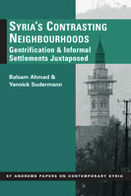
Vol 3, No 2 (2011): Syria’s Contrasting Neighbourhoods: Gentrification and Informal Settlements Juxtaposed
The full text of this volume is currently available in print only, from Lynne Reinner publishers at https://www.rienner.com/
2010
2009
2008
Monday, April 25, 2016
Conflict Urbanism Aleppo
Conflict Urbanism: Aleppo is a project in two stages.
First, we have built an open-source, interactive, data-rich map of the city of Aleppo, at the neighborhood scale. Users can navigate the city, with the aid of high resolution satellite imagery from before and during the current civil war, and explore geo-located data about cultural sites and urban damage. We will add data as it becomes available; currently we are grateful for datasets from from Human Rights Watch, the United Nations Operational Satellite Applications Programme (UNOSAT), and the Humanitarian Information Unit (HIU) at the U.S. Department of State.
Second, the map is a platform into which additional data of all sorts can be integrated. It is an invitation to students and invited collaborators to record and narrate urban damage in Aleppo — at the cultural, infrastructural, or neighborhood scale — and to present that research in case studies which will be added to the website over time.
We invite ideas and propositions, and hope to build on the data that we have compiled here to develop further research on and engagement with the situation in Aleppo. It is a call for inquiry and a call to action.
Since 2012, the people of Aleppo — one of the oldest continuously-inhabited cities in the world — have been exposed to catastrophic violence. Many thousands have been injured, died, or fled. Our project focuses on their city and what has been done to it and what might happen to it in the future.
Subscribe to:
Posts (Atom)