Showing posts with label Ottoman. Show all posts

Wednesday, April 16, 2025

OA Book: Tıflî Hikâyeleri


 Tıflî Hikâyeleri by David Selim Sayers 

"IV. Murad İstanbul’unda geçen ve cinsellik, para, aşk ve şiddet gibi konuları işleyen Tıflî hikâyeleri, 19. yüzyıl Osmanlı düzyazı edebiyatının önemli bir türünü oluşturur. Bu edebî türle ilgili ilk ve tek kapsamlı çalışma olan Tıfli Hikâyeleri, 19. yüzyıl Osmanlı kültürünün de çarpıcı bir panoramasını sunuyor. Kitap, hikâyelere ilişkin inceleme dışında eski yazıdan çeviri yazısı yapılan hikâye metinlerini de içeriyor. 

The Tifli Stories are a genre of Ottoman prose literature set in Istanbul during the reign of Murad IV (r. 1623-1640) and revolving around themes such as sex, money, passion, and violence. The first and only comprehensive study of this literary genre, Tifli Hikayeleri (The Tifli Stories) analyzes the stories to offer a vivid panorama of 19th-century Ottoman culture. The book further includes a comprehensive corpus of stories transliterated from Ottoman into modern Turkish."

URL, Paris Institute: https://parisinstitute.org/tifli-hikayeleri/ 

Friday, February 9, 2024

Collection of Ottoman censuses on the website of the Hungarian National Archives


"„Oszmán összeírások gyűjteménye” a Magyar Nemzeti Levéltár honlapján"

by Szepesiné Simon Éva, National a Hungary

The database "Collection of Ottoman censuses", available at Adatbázisok Online of the National Archives of Hungary, provides an insight into the Ottoman period and the struggling daily life of the Ottoman-Hungarian border region. The database, which currently contains some 26 300 records, primarily focuses on income and property records obtained from the Ottoman tax registers (tapu defterleri) covering the territory of the Kingdom of Hungary and makes them accessible to all, but the structure of the database is suitable for displaying all administrative units of the Ottoman Empire in the future. The collection, which offers both easy and quick access and comparative research, is recommended not only for historians, but for those interested in military history or the past of their localities, too."


Ottoman Censuseshttps://www.archivesportaleurope.net/blog/collection-of-ottoman-censuses-on-the-website-of-the-hungarian-national-archives/

Friday, February 2, 2024

Monday, February 7, 2022

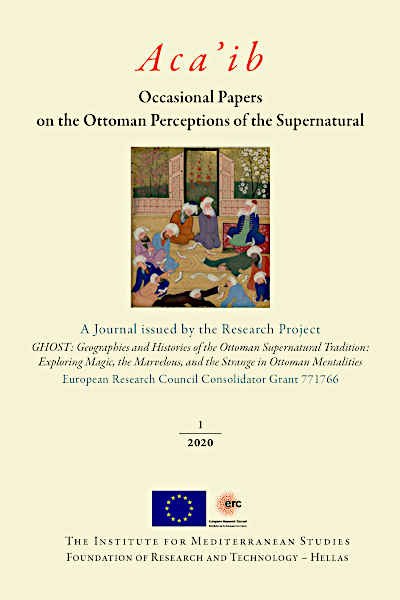
New OA journal: ACA’IB: OCCASIONAL PAPERS ON THE OTTOMAN PERCEPTIONS OF THE SUPERNATURAL


"The journal Aca’ib: Occasional papers on the Ottoman perceptions of the supernatural publishes original research articles in English and French, research reports (including reports on scientific meetings), source presentations, book reviews and translations of sources pertaining to Ottoman occultism, science and beliefs on supernatural phenomena. This journal forms part of a five-year research project, “GHOST”: Geographies and Histories of the Ottoman Supernatural Tradition: Exploring Magic, the Marvelous, and the Strange in Ottoman Mentalities”, funded by the European Research Council under the program Consolidator Grant 2017. The journal aims at keeping the community informed of our activities, presenting some sources and literature surveys, but also serving as a forum for scholars interested in such topics. There are four issues scheduled until the end of the project (February 2023), but the Editors will do their best to continue publication afterwards.

The journal covers research on Ottoman occult sciences (divination, oneiromancy, magic, science of letters, astrology, alchemy etc.) or specific treatises thereof; Ottoman theological or philosophical discussions on Hermeticism, the limits of knowledge, the reality of miracles, the existence of natural laws and so forth; Ottoman collections of strange stories and phenomena and their epistemological background; history of Ottoman science with emphasis on new explanations of phenomena previously considered inexplicable or supernatural."


Thursday, November 4, 2021

New OA Book: Intra-European Litigation in Eighteenth-Century Izmir


"Scholars have long debated the use of law to settle international trade disputes in the early modern period. In this book, Tijl Vanneste uses the case study of commercial litigation before the Dutch consular court of Izmir to argue that merchants relied on a particular blend of mercantile customs, which he calls ‘the merchants’ style’, and specific legal forms and procedures, laid down in written regulations, and dependent on local and international circumstances. The book challenges the idea of a universal ‘law merchant’, to replace it with a more nuanced analysis that centralizes the interplay between informal merchant custom, as advocated by traders and judges alike, and formal procedural legislation, drawn mostly from Roman law, in the resolution of mercantile disputes."

Copyright Year: 2022
E-Book (PDF)
Availability: Published ISBN: 978-90-04-49823-5Publication Date: 01 Nov 2021

Link: https://brill.com/view/title/39091. 

Friday, October 1, 2021

New OA Book: Osmanlı Dönemi İzmir Plan ve Haritaları


Osmanlı Dönemi
İzmir Plan ve Haritaları

19. yüzyılda Osmanlı Devleti’nin başkent İstanbul’dan sonra ikinci büyük ticaret merkezi olan İzmir’in bu süreçte geçirdiği dönüşümü plan ve haritalar eşliğinde bizlere sunan kitapta, bu dönemde hazırlanmış plan ve haritalar ilk kez bir araya getirilmiştir.

ISBN: 9786055826246 6055826240

İzmir Plan ve Haritaları: https://kulturyayinlari.izka.org.tr/osmanli-donemi-izmir-plan-ve-haritalari/

Monday, September 13, 2021

New OA book: A Handbook and Reader of Ottoman Arabic


"Written forms of Arabic composed during the era of the Ottoman Empire present an immensely fruitful linguistic topic. Extant texts display a proximity to the vernacular that cannot be encountered in any other surviving historical Arabic material, and thus provide unprecedented access to Arabic language history.

This rich material remains very little explored. Traditionally, scholarship on Arabic has focussed overwhelmingly on the literature of the various Golden Ages between the 8th and 13th centuries, whereas texts from the 15th century onwards have often been viewed as corrupted and not worthy of study. The lack of interest in Ottoman Arabic culture and literacy left these sources almost completely neglected in university courses.

This volume is the first linguistic work to focus exclusively on varieties of Christian, Jewish and Muslim Arabic in the Ottoman Empire of the 15th to the 20th centuries, and present Ottoman Arabic material in a didactic and easily accessible way. Split into a Handbook and a Reader section, the book provides a historical introduction to Ottoman literacy, translation studies, vernacularisation processes, language policy and linguistic pluralism. The second part contains excerpts from more than forty sources, edited and translated by a diverse network of scholars.

The material presented includes a large number of yet unedited texts, such as Christian Arabic letters from the Prize Paper collections, mercantile correspondence and notebooks found in the Library of Gotha, and Garshuni texts from archives of Syriac patriarchs."

A Handbook and Reader of Ottoman Arabic
Esther-Miriam Wagner (ed.) | September 2021
488pp. | 4 B&W or colour illustration | 6.14" x 9.21" (234 x 156 mm)
Semitic Languages and Cultures | ISSN: 2632-6906 (Print); 2632-6914 (Online)ISBN Paperback: 9781783749416
ISBN Hardback: 9781783749423
ISBN Digital (PDF): 9781783749430

DOI: 10.11647/OBP.0208
Subject Codes: BIC: CFF (Historical and comparative linguistics), CFP (Translation and interpretation); BISAC: REL006020 (RELIGION / Biblical Biography / General), LAN009010 (LANGUAGE ARTS & DISCIPLINES / Linguistics / Historical & Comparative)

Link: https://www.openbookpublishers.com/product/1168

Monday, January 25, 2021

Digital Ottoman Studies


Digital Ottoman Studies
"Digital Humanities is a new field that grows rapidly in the academic environment. This website is designed as a hub for digital projects, tools, events, publications, and platforms to contribute to Digital Humanities from the perspective of Ottoman and Turkish Studies. The 600-year-old Ottoman Empire's archival heritage, spanning diverse ethnic and geographical regions, holds high potential for digital humanities. This website aims to create a digital network for future projects by bringing together studies, people, and institutions. "

Thursday, August 6, 2020

Open Access Newspaper Archive - Turkish/Ottoman Periodicals (Digitization Project "Translatio")

Digitization Project "Translatio"  from the Universitäts- und Landesbibliothek Bonn makes available digital copies of Persian, Arabic, and Turkish periodicals.
Each title has a WorldCat record, albeit in German transliteration, with link to digitized content. For each entry there is a Wikipedia page in German, Arabic and other languages, presumably created by the Translatio project. Wikipedia entries include references to other sources. Single volumes of the newspapers are downloadable

See also: A Chronology of Arabic, Persian and Ottoman-Turkish Periodicals

In addition to listing the individual titles on the A-Z list of historical newspapers AMIR editors are providing variant spelling of the titles to improve discovery of these archives on the web.
Suggestions/corrections are welcome as always.

22 Turkish/Ottoman titles, some from reprints.
انادولو مجموعه سى = Anadolu mecmuası = Anadolu meǧmūʻasï 1924-25
آشیان = Āshiyān = Āšiyān 1918
 آى دده = Āydede 1922
Aydede 1948-1949
داوول = Davul 1909-1910
 ‏دمت‎ = Demet 1908
دیوژن = Diyojen = Diyožen = Diyōzhen 1870-1873
انوار ذكا = Envār-i Zekā = Enwār-i d̲ekā = Envar-i zeka  1882-1883
 اشرف = Muṣavver eşref = Ešref  1909
گولريوز = Güleryüz 1921-1923
حميت = Ḥamīyet  1886
حيات = Hayāt 1926-1929
Her ay 1937-1938
حکمت‎ = Ḥikmet 1910-1911
Kadro 1932-1935
 قره‌گوز = Karagöz = Karaguez = Qaragöz 1920-1928
 ‏محرر‎ = Muharrir 1876-1879
ناھید = Nāhīd 1886-1887
رسملى آى = Resimli ay 1924-1938
‏شهبال‎ = Şehbāl = Šehbāl = Chehbal 1909-1914
 سويملى آى = Sewimli ay 1925-1938
Yarım ay 1935-1940


Thursday, June 18, 2020

New OA Project: Medieval and Early Modern Orients (MEMOs)


"Medieval and Early Modern Orients (MEMOs) is an AHRC-funded project that seeks to further knowledge and understanding of the early interactions between England and the Islamic worlds. Through our pages and our blog we hope to create an accessible space to reveal the exciting discoveries of researchers as they navigate the seas of history and literature, and investigate the intersecting webs of our pasts.

Like the engagements it explores, MEMOs is also a point of engagement. It is a space for researchers, practitioners and anyone with an interest to connect and stay up-to-date with news and events in the field, as well as the work of colleagues and specialists. By this we hope to build a network of knowledge and appreciation around the longstanding global relationships that continue to define our interconnected identities and shape our world."

Website: https://memorients.com/

Tuesday, June 16, 2020

Digital Sources for the Study of the Ottoman Empire and Turkey


Digital Sources for the Study of the Ottoman Empire and Turkey.
by Nicole A.N.M. van Os, PhD

"Increasingly, primary sources from the period before the emergence of digital media are being digitized. These “digital surrogates” have facilitated the work of (historical) researchers; instead of having to visit several archives, libraries and other places, the (primary) sources appear in front of them on their screen while they are sitting in their study at home or the university."

Monday, April 8, 2019

Universität Bonn: Translatio digitization project


"Within the framework of a project supported by the Ministry for Innovation, Science and Research of the state of North-Rhine Westphalia (duration 1.11.2013 – 31.10.2014) the Institute for Oriental and Asian Studies of the University of Bonn would like to research how European concepts had been discursively acquired between 1860 and 1945 in Asian and Middle Eastern societies.The aim of the project is to make the very scattered source materials on – to a scientific high degree innovative and for numerous colleagues connectable theme “Translation. The cognitive acquisition of European key concepts in Asian and Middle Eastern societies (1860-1945)” in a first step digital and in one place accessible. Relevant sources from the Middle Eastern and Asian saddle period shall be digitised, exploited and put on the research platform for evaluation and further work from the period 1860-1945: periodicals, lexica, encyclopedias, political publications, remissions and Ego-documents. As periodicals are the basis of the developed public sphere of the aforementioned period, these periodicals form the most important and most extensive primary texts for a conceptual history."

See.

52 titles have been digitized in Arabic, Persian and Ottoman.

Arabic: http://digitale-sammlungen.ulb.uni-bonn.de/topic/titles/3080606

Persian: http://digitale-sammlungen.ulb.uni-bonn.de/topic/titles/3080607

Ottoman: http://digitale-sammlungen.ulb.uni-bonn.de/topic/titles/3085789.


Wednesday, April 18, 2018

Historiography of Early Modern Ottoman Europe (HOE) Database

https://hoe.ub.rub.de/index


HOE is a collection of meta-data focusing on historiographical writing of Early Modern Ottoman Europe (1500-1800). It brings together published and unpublished primary sources (chronicles, histories, hagiographies, inscriptions, maps…), as well as secondary material (“Main Section”). It also offers information on specific collections, as well as a wide variety of references to tools and resources useful to those navigating the research questions of Early Modern historiography (“Tools Section”).

HOE provides information on the author(s), title(s), contents, manuscript(s) and edition(s) of the main sources related to the topic. Regarding these sources, it offers bibliographical meta-data in the form of both library-specific and internationally recognized identifiers. This information is augmented by links to online resources and related literature. Thus, HOE allows for quick and comprehensive overview of where to find primary sources, who was/is connected to their generation and proliferation, which secondary sources in which editions, printed and online there are, etc.… It is a research tool for easy, comprehensive, quality reference.

You can switch between the Main Section and the Tool Section at will. Different facets and filters will help you refine your search.

If you are looking for specific works, you can use the search function to find its title, transcribed title or translated title. In each entry, different pieces of related information and links are made available, depending on the type of source you have selected. And in every case, there will be links to its related sources, which allow you to quickly and precisely access a source’s siblings or derivates.

URL


Wednesday, March 7, 2018

SALT Araştırma: Digitized French Press in the Ottoman Empire

SALT Araştırma: Digitized French Press in the Ottoman Empire.

"This project, a collaboration between İstanbul Atatürk Library, Bibliothèque Nationale de France and Institut Français d’Études Anatoliennes, aims to digitize newspapers and magazines published in French from the second half of the 19th century to the 1930s. More than a hundred titles, including periodicals printed in the Ottoman Empire as well as media published by the Young Turks of Europe, are now accessible. İstanbul Atatürk Library’s collection of Franco-Ottoman press has been digitalized by SALT Research, while the collection of Bibliothèque Nationale de France can be accessed through Gallica."


Available journals include:
 Alem
 Byzantia
 Djem
 Felek
 Hamenora
 Hokkabaz
 İctihâd
 Kalem
 L'Orient
 Maarifet
 Malumat
 P’ST
See: Digitized French Press in the Ottoman Empire

Monday, February 26, 2018

Database for Ottoman Inscriptions -Osmanli Kitableri Projesi

Database for Ottoman Inscriptions -Osmanli Kitableri Projesi
OTTOMANINSCRIPTIONS
The Database of Ottoman Inscriptions (DOI) is searchable digital database comprising information about, as well as transliterations and pictures of, all the Turkish, Arabic and Persian architectural inscriptions created in the Ottoman lands during Ottoman times. For more information, click here.

Wednesday, July 13, 2016

LexiQamus: Solving illegible words in Ottoman Turkish

LexiQamus

[First posted in AMIR on Wednesday, July 13, 2016. ]
[Update: October 27, 2017 - This resource now requires registration and paid subscription]

I have created a website whose main purpose is to solve illegible words in Ottoman Turkish which is especially critical for those dealing with archive documents. Prof. Edhem Eldem at Bogazici University, my previous thesis supervisor during my master's in the history department, fervently encouraged me for this project.
For the time being, it explores only the words in Ottoman Turkish, but Arabic and Persian words will be included in the database soon. However, it can already find words in these language due to the huge size of the database.
This is what basically it does: You fill in legible letters in the boxes and put a * for illegible ones, then it provides you with a list of possible words that match your criteria, going through a list of approximately 170 thousands words...
The words and phrases come from more than 15 prominent dictionaries. For this project only, all the entries (including phrases, not just the main entries, 150 thousands in total) of Lexicon (Ottoman Turkish to English) published by James Redhouse in 1890 were typed and added to the database.
Here is the list of those dictionaries:
Kamus-ı Türki - Türkçe'den Türkçe'ye Osmanlı harfleri ile sözlük
Lûgat-ı Naci - Türkçe'den Türkçe'ye Osmanlı harfleri ile sözlük
Kamus-ı Osmani - Mehmed Salahi Bey Osmanlıca sözlüğü
Lûgat-ı Remzi - Doktor Hüseyin Remzi Bey'in sözlüğü
Lehce-i Osmani - Ahmet Vefik Paşa Osmanlıca sözlüğü
Lûgat-ı Ebuzziya Tevfik
Resimli Kamus-ı Osmani - Ali Seydi
Lûgat-ı Cudi
Mükemmel Osmanlı Lûgatı - Faik Reşat & Ali Nazım
Müntab-ı Lûgat-ı Osmaniye
Yeni Türkçe Lûgat
Türkçe Kamus
Kamus-ı Fransevi
Osmanlıca - Almanca Sözlük
Hazine-i Lugat

Tuesday, July 7, 2015

Open Access Monograph Series: Hilâl. Studi turchi e ottomani

Hilâl. Studi turchi e ottomani
http://virgo.unive.it/ecf-workflow/script/loghi/Hilal_Tile.png
La collana, diretta da Maria Pia Pedani ed Elisabetta Ragagnin, raccoglie monografie, edizioni di fonti e atti di convegni relativi alla storia del mondo turco-ottomano e dei popoli turco-mongoli che vissero nell’area euroasiatica, senza dimenticare lingue e filologia, elementi base per potersi avvicinare alle fonti storiche. Saranno privilegiati gli argomenti che riguardano la storia dei rapporti tra l’Italia, e Venezia in particolare, e i paesi dell’Asia.

Volumi pubblicati

02.2013 - Vol. 1

Tra quattro paradisi

a cura di Antonio Fabris
02.2013 - Vol. 2

Osmanlı Pâdişah Türbeleri. Ottoman rulers’ tombs

a cura di Mehmet Fatih Demirhan
12.2013 - Vol. 3

Il Palazzo di Venezia a Istanbul e i suoi antichi abitanti

a cura di Maria Pia Pedani
04.2014 - Vol. 4

Venedik Baylosu’nun Defterleri | The Venetian Baylo’s Registers (1589-1684)

Serap Mumcu
Bu kitap Venedik Devlet Ars¸ivınde bulunan 940 Osmanlıca belgenin özetlerini içermektedir. I˙stanbul’daki diplomatlar tarafından tutulan ...

Wednesday, February 25, 2015

The Online Bibliography of Ottoman-Turkish Literature - Osmanlı Edebiyatı Bibliyografyası Veritabanı

The Online Bibliography of Ottoman-Turkish Literature - Osmanlı Edebiyatı Bibliyografyası Veritabanı


http://ottomanliterature.com/Images/Masthead_en.png
http://www.osmanliedebiyati.com/Images/Masthead_tr.png
Welcome to The Online Bibliography of Ottoman-Turkish Literature, a free and extensive database of references to theses, books, articles, papers and projects relating to research into Ottoman-Turkish culture. Please visit the Turkish version of this site if your first language is Turkish. 

The bibliography aims to serve as the principal reference for scholars working on Turkey and the Middle East, and for specialists studying other medieval and early/modern literatures. It is open also to record-submissions from visitors, and we invite all relevant scholars and researchers to post entries relating to their works. Such submissions become available publicly following review. 

To get started, click the Search button now or press the Enter key. This will retrieve the entire contents of the database, and will cause this introduction to disappear automatically. Please refresh this page in your browser should you wish to view this text again. Alternatively, you may wish to visit the Information section for detailed explanations of all aspects of this site.

If you wish to symbolise a link to this site from another by means of an icon, you may wish to employ the image that you see here to the right. To use this, drag a copy of the icon onto your desktop and proceed accordingly from there. See the section on icons in the Information pages for further information and for icons of different sizes. 

Note that the Turkish and English versions of this site differ in the language in which they deliver their static content (labels, button-legends, etc.), but not in the language in which a given record was submitted. Note also that this site employs JavaScript extensively, such that disabling JavaScript in your browser renders the database-functionality inoperable. Nevertheless, this site is safe to use in that it does not employ ActiveX technologies, nor JavaScript from external sources.