Showing posts with label Syria. Show all posts

Thursday, April 21, 2022

300 Syria Report articles available

Syria Report, which is otherwise a commercial, subscription based resource has made 300 articles available free of charge. 

"For the past 18 months The Syria Report has been covering housing, land, and property (HLP) rights stories across Syria. We have published news stories, analyses, a glossary of terms and expressions and interviews on various HLP aspects across all areas of control in Syria.
You can read them all on the following page:
https://syria-report.com/category/hlp/

As all Syria Report content, HLP section is searchable through our search engine. The same 300 articles are also available in Arabic. "

Thursday, June 10, 2021

Open Access E-book: A Sultan in Autumn: Erdogan Faces Turkey's Uncontainable Forces


"The unprecedented economic growth and personal popularity once enjoyed by the Turkish leader have given way to stagnation, a dwindling support base, and problems abroad.

During his first decade in power, Turkey’s Recep Tayyip Erdogan maintained his popularity by delivering unprecedented economic growth and dramatically increasing access to healthcare, education, and other essential services. But in recent years, he and his party have faced setbacks, including humiliating mayoral election losses in Istanbul, Ankara, and other major cities in 2019. At home, the once robust Turkish economy has sputtered, while abroad Erdogan must balance a perilous alliance with Russia’s Vladimir Putin against the need to maintain amicable relations with Washington. A potential refugee crisis from Syria looms as another threat. And on the political front, Erdogan can no longer count on majority support from Turkish voters, a trend driven by disillusionment among millennials, his own clumsy anti-elitist messaging, and establishment fatigue, among other factors.

In this taut and compelling volume—copublished by The Washington Institute and I.B. Tauris—Soner Cagaptay lays out the mounting challenges to Erdogan’s rule. While suggesting the adaptive president may still survive politically—with undoubted costs for Turkey’s citizens, institutions, and allies—he also offers a more hopeful subtext, intimating that the country’s resilient democracy can outlast any one leader."

Acknowledgments x 
Abbreviations xi 
Preface xii 
Introduction xviii 
1 The Underdog 1 
2 Erdogan’s Turkey at a Glance 5 
3 Conqueror of Kemalism 13 
4 The Many Faces of Erdogan 23 
5 Erdogan’s Worst Enemy? 29 
6 How Putin Won Erdogan’s Heart—and How Obama Lost It 41 
7 Between Putin and Biden 59 
8 Democratic Tsunami 77 
9 Erdogan’s Game Plan 89 
10 But Will He Succeed? 99 
11 The Sultan’s Legacy 109


Ebook: https://www.washingtoninstitute.org/media/4600 

Friday, June 4, 2021

OA E-book: Antique Dealing and Creative Reuse in Cairo and Damascus 1850-1890: Intercultural Engagements with Architecture and Craft in the Age of Travel and Reform


Antique Dealing and Creative Reuse in Cairo and Damascus 1850-1890: Intercultural Engagements with Architecture and Craft in the Age of Travel and Reform
Publication Date: 25 May 2021

ISBN: 9789004449886

The commodification of Islamic antiques intensified in the late Ottoman Empire, an age of domestic reform and increased European interference following the Tanzimat (reorganisation) of 1839. Mercedes Volait examines the social life of typical objects moving from Cairo and Damascus to Paris, London, and beyond, uncovers the range of agencies and subjectivities involved in the trade of architectural salvage and historic handicraft, and traces impacts on private interiors, through creative reuse and Revival design, in Egypt, Europe and America. By devoting attention to both local and global engagements with Middle Eastern tangible heritage, the present volume invites to look anew at Orientalism in art and interior design, the canon of Islamic architecture and the translocation of historic works of art.

E-book: https://brill.com/view/title/59736. 


Wednesday, July 8, 2020

New OA resource: Syrian Heritage Archive Project


Until now, a general register for Syrian cultural heritage has been lacking. Several Syrian and international initiatives are working together on a compilation of the abundant research data collected over the past decades within the framework of archaeological and art-historical projects, with the content made accessible for research via a national Syrian Heritage register.

In 2013, the Museum of Islamic Art (National Museums in Berlin) and the German Archaeological Institute (DAI) started the “Project for the Establishment of a Digital Heritage Register for Syria”/“Projekt zur Erstellung digitaler Kulturgüterregister für Syrien”. This original name was soon replaced by a shorter English version: “Syrian Heritage Archive Project”, commonly abbreviated as SyrHer or SHAP. From the very beginning, the project was funded by the Cultural Preservation Program maintained by the German Foreign Office.

This website is the responsibility of the subteam of the Museum of Islamic Art.

A detailed documentation of Syria’s cultural heritage provides a basis for recording damage and destruction from the war and for possible future reconstruction measures. The awareness of a common cultural heritage may become an important component for national reconciliation processes in the future.

Thursday, December 5, 2019

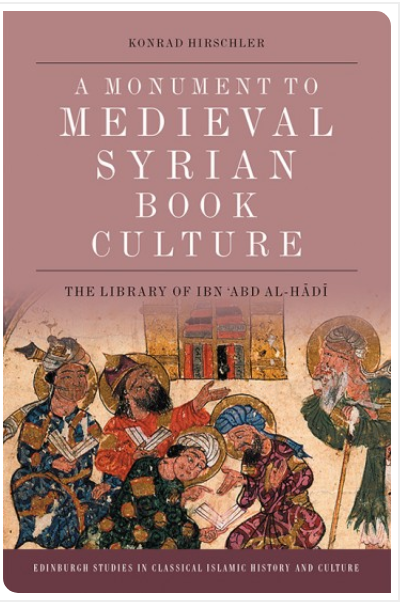
Open Access Book: A Monument to Medieval Syrian Book Culture The Library of Ibn ʿAbd al-Hādī

Author: Konrad Hirschler
Title: A Monument to Medieval Syrian Book Culture The Library of Ibn ʿAbd al-Hādī
Published: Edinburgh Studies in Classical Islamic History and Culture. November 2019
ISBN: 9781474451598 (PDF)

Reassembles the books of a medieval Arabic library that are today dispersed around the world Sets out a new approach to the study of Arabic book culture

Edits the most important Arabic medieval book list
Provides a new angle on the history of ḥadīth in the late-medieval period
Reconceptualises the mobility of endowed books
Reproduces the entire catalogue in colour

In the late medieval period, manuscripts galore circulated in Middle Eastern libraries. Yet very few book collections have come down to us as such or have left a documentary trail. This book discusses the largest private book collection of the pre-Ottoman Arabic Middle East for which we have both a paper trail and a surviving corpus of the manuscripts that once sat on its shelves: the Ibn ʿAbd al-Hādī Library of Damascus. The book suggests that this library was part of the owner’s symbolic strategy to monumentalise a vanishing world of scholarship bound to his life, family, quarter and home city.


Monday, June 12, 2017

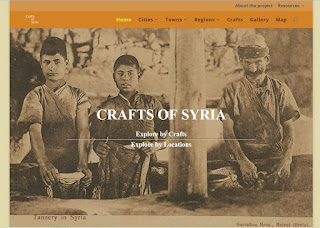
Crafts of Syria

http://craftsofsyria.uvic.ca/


Crafts of Syria

"... Many of the monuments and archaeological sites have been looted, with some deliberately destroyed during the conflict. The crafts are another significant component of the rich cultural heritage of Syria, and this site is intended to preserve information on aspects of traditional manufacturing practices of urban and rural areas. It is hoped that this will be a resource for students and researchers working on the material cultures and socio-economic life of Syria and the surrounding regions of the Middle East.
This site is organized according to the cities, towns, and other settlements of modern Syria. Within each of these you will find primary written sources, secondary historical studies, ethnographic and archaeological research, and photographs that provide evidence for craft activities conducted in these locations across Syria from the seventh century to the present. The site will also be complemented by a range of resources designed to aid in the study of the craft traditions of this region. Some are already available on the site, and others will be added soon. These comprise: essays dealing with specific aspects of the crafts of Islamic Syria, links to related archives and collections, maps, short biographies of major primary sources, a glossary of technical terms, and a bibliography."

Tuesday, December 27, 2016

Syria: A Living History (exhibition catalogue, Aga Khan Museum, Toronto)


https://www.agakhanmuseum.org/sites/default/files/downloadable/AKM_EXH_Syria-exhibition-companion-book.pdf

Syria: A Living History 

Oct 15 2016 to Feb 26 2017

Few countries have captured the world’s attention like Syria has today. Stories of conflict and displacement dominate the media and define people’s awareness of the place. Syria: A Living History brings together artifacts and artworks that tell a different story — one of cultural diversity, historical continuity, resourcefulness, and resilience. For over five millennia, this region perched on the eastern Mediterranean has witnessed great world civilizations commingling on its soil and producing art, literature, and culture that constitute the country’s rich legacy. Strongly informed by a distinctive landscape and history, artists of Syria throughout the ages have made priceless contributions to world heritage. Syria: A Living History inspires new understanding of Syria’s past and present, and invites new ways of thinking about its future.

Co-Curators
Dr. Filiz Çakır Phillip, Aga Khan Museum
Professor Nasser Rabbat, Aga Khan Program for Islamic Architecture, MIT

Historian
Dr. Ross Burns, Sydney, Australia

https://www.agakhanmuseum.org/exhibitions/syria-living-history 

Tuesday, September 27, 2016

Open Access Atlas: Syria & Iraq

http://www.ecoi.net//atlas_syria_iraq.pdf


Atlas: Syria & Iraq
Published by: Austrian Federal Ministry of the Interior,
Year: 2016
ISBN: 9783950364378

Table of contents:
Regional overview..................................................................................................6
Syria & Iraq: Topography and administrative divisions........................................8
Syria & Iraq:  Physiography..................................................................................10
Syria & Iraq: Control of territory January 2015....................................................12
Syria & Iraq: Control of territory June 2016..........................................................14
Syria & Iraq: Major Clashes January 2015 –June  2016........................................16
Syria & Iraq: Religious and sectarian groups January  2014..................................18
Syria & Iraq: Ethnic and linguistic groups January 2014.......................................20
Kurds in the Middle East.........................................................................................22
Oil and gas fields in Iraq and Syria.........................................................................24
Camps for Syrian and Iraqi refugees and IDPs 2016.............................................26
Syrian/Iraqi citizens and Syrian/Iraqi-born population 2015..... ...........................28
Asylum applications of Syrian/Iraqi citizens 2015................................................30
Syrian/Iraqi refugees and IDPs 2015.....................................................................32

Wednesday, May 4, 2016

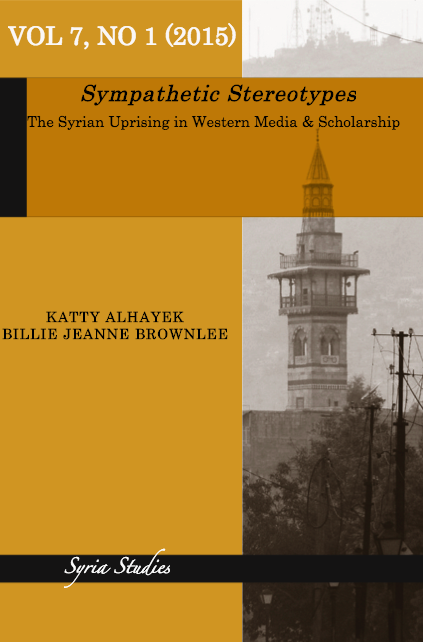
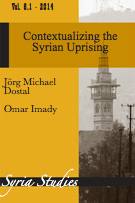
Open Access Journal: Syria Studies

Syria Studies
ISSN: 2056-3175
Welcome to Syria Studies, the official online journal of the Centre for Syrian Studies (CSS) at the University of St. Andrews. Syria Studiesis a peer reviewed and indexed journal that has previously been published in hard form. We are proud to include on our Board of Reviewers some of the most renowned authorities on Syria.

The aim of Syria Studies is to provide a space for scholars and students to publish work focused on the study of modern and contemporary Syria (history, politics, economy, & society). Given the interdisciplinary nature of Syria Studies, high-quality submissions from various academic and professional backgrounds are encouraged. -- Raymond Hinnebusch, Director of CSS


2013

Cover Page

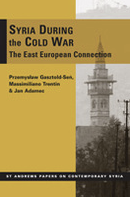
Vol 5, No 2 (2013): Syria During the Cold War

The full text of this volume is currently available in print only, from Lynne Reinner publishers at https://www.rienner.com/
Cover Page

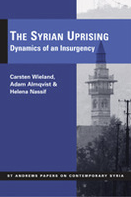
Vol 5, No 1 (2013): The Syrian Uprising

The full text of this volume is currently available in print only, from Lynne Reinner publishers at https://www.rienner.com/

2012

Cover Page

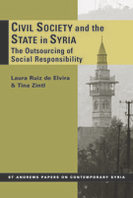
Vol 4, No 2 (2012): Civil Society and the State in Syria: The Outsourcing of Social Responsibility

The full text of this volume is currently available in print only, from Lynne Reinner publishers at https://www.rienner.com/
Cover Page

Vol 4, No 1 (2012): State and Islam in Baathist Syria: Confrontation or Co-optation?

The full text of this volume is currently available in print only, from Lynne Reinner publishers at https://www.rienner.com/


2008

Monday, April 25, 2016

Conflict Urbanism Aleppo

Conflict Urbanism Aleppo
Conflict Urbanism: Aleppo is a project in two stages.

First, we have built an open-source, interactive, data-rich map of the city of Aleppo, at the neighborhood scale. Users can navigate the city, with the aid of high resolution satellite imagery from before and during the current civil war, and explore geo-located data about cultural sites and urban damage. We will add data as it becomes available; currently we are grateful for datasets from from Human Rights Watch, the United Nations Operational Satellite Applications Programme (UNOSAT), and the Humanitarian Information Unit (HIU) at the U.S. Department of State.

Second, the map is a platform into which additional data of all sorts can be integrated. It is an invitation to students and invited collaborators to record and narrate urban damage in Aleppo — at the cultural, infrastructural, or neighborhood scale — and to present that research in case studies which will be added to the website over time.

We invite ideas and propositions, and hope to build on the data that we have compiled here to develop further research on and engagement with the situation in Aleppo. It is a call for inquiry and a call to action.

Since 2012, the people of Aleppo — one of the oldest continuously-inhabited cities in the world — have been exposed to catastrophic violence. Many thousands have been injured, died, or fled. Our project focuses on their city and what has been done to it and what might happen to it in the future.

Tuesday, October 14, 2014

Open Access Magazine: Dabiq

Dabiq

[UPDATE 6/21/2022.  Clarion Project no longer hosts copies of the Dabiq.
Archived copies of some issues are available on the Internet Archive. 
See:  https://archive.org/search.php?query=dabiq ]


The Islamic State's (ISIS, ISIL, Daesh) Magazine. Scans of Dabiq have been made available online by The Clarion Project.
The Islamic State (ISIS) regularly puts out a glossy propaganda magazine aimed at recruiting jihadists from the West. It is sophisticated, slick, beautifully produced and printed in several languages including English...

'Dabiq' as it is called, bills itself as "a periodical magazine focusing on the issues of tawhid (unity), manhaj (truth-seeking), hijrah (migration), jihad (holy war) and jama'ah (community). It will also contain photo reports, current events, and informative articles on matters relating to the Islamic State."

It portrays the Islamic State as they see themselves: boasting of their victories and painting a romantic image of the restoration of an Islamic golden age and the heralding of a glorious new Caliphate based on holy war. 

Dabiq is a place in Syria that is supposed to be the location for one of the final battles according to certain Muslim myths about a final apocalypse. Choosing such a name for the magazine highlights the Caliphate's goals...
In order to combat extremist groups, it is important to understand their underlying ideology. Therefore, Clarion Project will continue to post the issues of Dabiq here as they are released.
Issues of Dabiq released so far: 
The twelfth issue of the Islamic State’s propaganda magazine is entitled Just Terror. It boasts about the terrorist attacks in Paris, the double-bombing in Beirut, and the downing of a Russian plane in Sinai among other attacks. It spins terrorism in the language of a fairy story, referring to terrorists as “knights,” acting to defend Muslim honor. This issue is also striking for the high number of Islamic State propaganda videos it advertizes, a sign of increased output in that area. Other pieces continue long-running themes, including attacking the legitimacy of other Islamist factions, recounting its military victories and attacking women who oppose polygyny as opposing Islam.  
Islamic State (ISIS, ISIL) Magazine: Dabiq - Issue 12
The eleventh issue of the Islamic State’s propaganda magazine is called From the Battle of Al-Ahzab to the War of Coalitions. Al-Ahzab refers to a battle in the Quran between a coalition of Meccan tribes and the nascent forces of Islam. ISIS attacks al-Qaeda and castigates the Taliban for concealing the death of Mullah Omar. ISIS also accuses the Shiite messiah (Mahdi) of being the dajjal (devil) in league with the Jews. More is directed at women, who are urged to have children and care for their jihadi husbands.
ISIS also tout their establishment of gold dinars as currency and boast of having captured a Norwegian and a Chinese hostage, who are offered up for ransom in full page adverts.
Islamic State (ISIS) Magazine: Dabiq Issue 11

The tenth issue of the Islamic State's Dabiq magazine is called The Laws of All or the Laws of Men. It opened by praising the deadly simultaneous terror attacks in Tunisia, Kuwait and France and the massive casualties caused. It calls on children to obey Allah (ie. ISIS) before their parents and wives to leave their husbands who fight ISIS. It also boasts of expansions in the Caucasus and recruitment in Afghanistan. 
Since it is the Ramadan issue, it discusses the historical victories of some of the early Muslim armies during Ramadan as well as expounding on the holiness of the month.
Islamic State (ISIS) Magazine: Dabiq Issue 10

The ninth issue of the Islamic State's Dabiq magazine is called They Plot and Allah Plots, referring to the central feature of the magazine which argues that Islamic State supporters should not fear any plans to defeat them since Allah controls the world. The issue focuses on legitimacy - both attacking that of its enemies in Syria and the surrounding Arab nations, and in building up its own, with pieces on the importance of jihad.
Most shockingly this issue ran a lengthy segments admitting to and justifying sex slavery. It threatens to sell US first Lady Michelle Obama into sexual slavery for a third of a dinar. 
Islamic State (ISIS) Magazine: Dabiq Issue 9

The eighth issue of the Islamic State's Dabiq magazine is called Shari'ah Alone Will Rule Africa. Like other issues of Dabiq it focuses on Islamic State successes, leaving out the group's defeats in strategic areas of Iraq and Syria to focus on Africa. It emphasizes the pledge of allegiance from Boko Haram in Nigeria and terror attacks in Libya and Tunisia. It tries to portray an organization with a future by glorifying its child soldier program and undermining the legitimacy of Al-Qaeda affiliat Jabhat al-Nusra by attacking its allies as 'nationalists' and therefore un-Islamic. 
Islamic State (ISIS) Magazine: Dabiq - Issue 8

The seventh issue of the Islamic State's Dabiq magazine is entitled From Hypocrisy to Apostasy. It begins with a declaration of war against Japan. Dabiq then boasts about the murder of the Jordanian pilot by immolation, before going on to give advice for would be leaders within the Islamic State. It reiterates their commitments to war, arguing that “Islam is the religion of the sword.” It then proceeds to tout its successes in Egypt and Libya. It reiterates its division of the world into two camps and includes interviews with jihadists and hostage John Cantlie. 
Islamic State (ISIS) Magazine: Dabiq - Issue 7

The sixth issue of Dabiq is called "Al-Qa'idah of Waziristan: A Testimony From Within." This issue begins by taking responsibility for the terrorist attack in Sydney that killed two at St. Martin's place and again calls on the Islamic State's supporters worldwide to carry out killings of Westerners whenever and wherever they can without revealing their intentions by discussing them. Most of the rest of the magazine focuses on internal jihadi disputes, criticizing the Islamic State's detractors from within the jihadi movement.  
Islamic State (ISIS) Magazine: Dabiq - Issue 6 

The fifth issue of Dabiq is named after the Islamic State slogan, 'Remaining and Expanding.' In this theme, it announces the expansion of the Islamic State into Sinai, Libya, Yemen, Algeria and the Arabian Peninsula after accepting pledges of loyalty (bay'ah) from terrorist groups there. It also announces the minting of gold dinars and silver dirhams in order to separate it from the international fiat currency markets and build the economy of the Islamist state. 
Islamic State (ISIS) Magazine: Dabiq - Issue 5

The fourth issue of Dabiq is entitled "The Failed Crusade." It focuses on the attempts by the U.S.-led coalition to counter the Islamic State and mocks what the Islamists regard as a campaign doomed to fail. They express their certainty saying "This religion is the one promised with victory." The picture on the cover is of the iconic St. Peter's Square in Rome, displaying the group's ambitions of world conquest.
Islamic State (ISIS) Magazine: Dabiq - Issue 4

The third issue of Dabiq, "The Call to Hijrah" focuses on the jihadists' call to Muslims worldwide to move to Iraq and Syria to join the caliphate as soon as possible. Hijrah is Arabic for 'migration' and refers to the journey of the founder of Islam, Mohammed, and his companions from Mecca to Medinah in 622 C.E. The comparison is very deliberate and intended to invoke religious nostalgia. 
Islamic State (ISIS) Magazine: Dabiq - Issue 3

The second issue of Dabiq, "The Flood," uses the metaphor of the story of Noah to put across a stark message: you are either with the Islamic State, or against them and doomed to be destroyed. It calls on all Muslims around the world to pledge loyalty to the Islamic State and to move there immediately. There is also a section on the attempts to resolve the disputes between the Islamic State and other Jihadi factions such as Jabhat al-Nusra by means of mubahalah, an Islamic religious arbitration process.
Islamic State (ISIS) Magazine: Dabiq - Issue 2

The first issue of Dabiq, "The Return of Khilafah" is focused on the declaration of the caliphate and what that means. Some of the ideology behind the group is explained in an attempt to persuade more Muslims to join. It also explains the name of the magazine, and boasts of ISIS' victories. It also talks about efforts made to build support among local tribal groups, reporting their pledges of loyalty to Abu Bakr al-Baghadi, the self-appointed caliph of the Islamic State.
Islamic State (ISIS) Magazine: Dabiq - Issue 1


Friday, May 16, 2014

OpenEdition Books: Dossiers: La Syrie

OpenEdition Books: Dossiers: La Syrie
http://static.openedition.org/books/images/portal/logo-oeb.png
Alors que la Syrie traverse une violente secousse sociétale et politique, OpenEdition Books propose de décaler notre regard sur cet espace pour saisir les dynamiques variées qui sont à l’œuvre à Damas ou Alep, à Homs ou dans les campagnes du nord. En croisant lectures historiques et contemporaines, analyses littéraires et sciences politiques, en passant par l’économie, les études culturelles et de la religion, ce dossier vous invite à comprendre la Syrie à travers une multiplicité et une contextualisation qui dépasse l’urgence médiatique.
Dossier préparé par Julie Abbou
28 octobre 2013
La construction nationale syrienne

La construction nationale syrienne

Légitimation de la nature communautaire du pouvoir par le discours historique

Stéphane Valter

CNRS Éditions, 2002

...
En Syrie, la nature étroitement communautaire du pouvoir (largement dominée par une minorité confessionnelle qui ne constitue que 12% de la population) a entraîné un effort particulier de légitimation.
Les tentatives de construction d’une identité nationale par le régime font ainsi référence à une continuité historique - partant, il faut le souligner, de l’époque antéislamique - sur une base territoriale assez stable. La mise en valeur, encouragée par le pouvoir, des vestiges archéologiques, dont le rôle est de renforcer le discours sur un passé lointain s’inscrit dans une production idéolog...

Liens personnels, clientélisme et réseaux de pouvoir dans le sultanat mamelouk (milieu XIIIe - fin XIVe siècle)
Les conflits qui imprégnèrent l’histoire du Proche-Orient médiéval, des croisades aux invasions mongoles, rendirent nécessaire la présence de guerriers au cœur du pouvoir. Les Mamelouks, esclaves militaires, affranchis pour accéder au titre d’émir, gouvernèrent l’Égypte et la Syrie, à partir de 1250, avec le titre de sultan, et furent de ceux qui défendirent le monde musulman contre les périls du temps.
La singularité de la société mamelouke tient non seulement au fait que d’anciens esclaves, capturés enfants dans les plaines d’Asie centrale et dans le Caucase, soient devenus des leaders pol...
Les Druzes de Syrie

Les Druzes de Syrie

Territoire et mobilité

Cyril Roussel

Presses de l’Ifpo, 2011

...
Cet ouvrage analyse l’espace produit par les membres de la communauté druze implantée depuis le xviiie siècle en Syrie méridionale, dans un massif montagneux qui a longtemps porté le nom de Djebel Druze. Cette région n’est devenue la « montagne druze » qu’après un long processus de territorialisation qui, en puisant dans l’histoire de la communauté, ses mythes et sa résistance héroïque face aux Ottomans, a favorisé la formation d’une identité communautaire propre aux Druzes du Djebel. Une telle construction identitaire et territoriale n’est pas restée sans conséquence ni dans l’organisation...
Le partage des eaux entre la Syrie, l’Irak et la Turquie

Le partage des eaux entre la Syrie, l’Irak et la Turquie

Négociation, sécurité et asymétrie des pouvoirs

Marwa Daoudy

CNRS Éditions, 2005

...
Comment les conflits liés à l’« or blanc » ont-ils évolué ? Si la « guerre de l’eau » au Moyen-Orient a longtemps prévalu dans la littérature spécialisée des années 1990, qu’en est-il aujourd’hui ? Quel est le poids de cet enjeu sur les dynamiques de pouvoir entre trois des acteurs clefs de la région - Syrie, Irak et Turquie ? Quelles furent les stratégies de négociation de la Syrie et de l’Irak, riverains en aval de l’Euphrate et du Tigre, face au puissant voisin turc en amont ?
L’auteur aborde ces questions par le biais des théories de la négociation et de l’examen critique des sessions de...

Les stratégies narratives dans la recension damascène de Sīrat al-Malik al-Ẓāhir Baybarṣ
Cette étude tente d’analyser les stratégies narratives d’un manuscrit de conteur de la recension damascène de Sīrat al-Malik al-Ẓāhir Baybar, et d’en déterminer les spécificités. En effet, si le genre sīra peut, comme tout récit, se ramener à une grammaire que partage l’ensemble des siyar, chaque recension peut également proposer des stratégies narratives qui lui sont propres. Au-delà des invariants, ce sont donc les variants et leur utilisation particulière qui constituent la spécificité de la recension de Damas. Des concepts fondamentaux du genre, comme la structure par épisodes, la répé...
Homs et Hama en Syrie centrale

Homs et Hama en Syrie centrale

Concurrence urbaine et développement régional

Mohamed al-Dbyiat

Presses de l’Ifpo, 1995

...
Bordée par les chaines de montagnes qui dominent la Méditerranée, traversée du sud au nord et d'est en ouest par les méandres de l'Oronte, la Syrie centrale offre au géographe un paysage relativement homogène. Les travaux hydrauliques, barrages, canaux d'irrigation, entrepris au cours de ce siècle, relayant les traditionnelles norias, ont donne son essor a l'agriculture de cette région, favorisant du même coup la démographie, et en ont fait une des plus riches régions agricoles de Syrie et du Croissant fertile. Homs et Hama, villes qui plongent leur racine dans l'Antiquité, se sont développ...
Maaloula (XIXe-XXIe siècles). Du vieux avec du neuf

Maaloula (XIXe-XXIe siècles). Du vieux avec du neuf

Histoire et identité d’un village chrétien de Syrie

Frédéric Pichon

Presses de l’Ifpo, 2010

...
Maaloula, dernier endroit au monde où se parle la langue du Christ, l’araméen… Lové au creux des montagnes du Qalamoun, le petit village ne cesse de fasciner tous les voyageurs depuis la fin du XVIIIe siècle. En effet depuis cette époque, il demeure une sorte de « lieu commun » orientaliste où se pressèrent érudits et missionnaires européens jusqu’à la première moitié du XXe siècle. Les plus grands orientalistes comme Theodor Nöldeke, des aventuriers tels que Richard Burton et même Alexandre Dumas connaissaient l’existence de Maaloula et lui consacrèrent quelques pages. Aujourd’hui, Maaloul...
Les institutions traditionnelles dans le monde arabe

Les institutions traditionnelles dans le monde arabe

Hervé Bleuchot (dir.)

Institut de recherches et d'études sur le monde arabe et musulman, 1996

...
On a souvent présenté les institutions du monde arabe sous des lumières très contrastées. On a ainsi décrit les institutions traditionnelles comme immobiles, acceptant la modernité à contre-coeur, incapables de correspondre aux besoins actuels, et donc condamnées à disparaître tôt ou tard devant des institutions modernes, puissantes et dynamiques. Ou, à l’inverse, on a décrit les anciennes comme toujours vivantes et hostiles au développement, les modernes n’étant que des paravents pour la propagande extérieure, des créations d’autant plus fragiles qu’elles seraient menacées par les projets ...
Nationalismes en mutation en Méditerranée orientale

Nationalismes en mutation en Méditerranée orientale

Alain Dieckhoff, Riva Kastoryano (dir.)

CNRS Éditions, 2002

...
Nationalisme, minorité, identité, communauté… Ces termes qui ont fait un retour en force dans les années 1990 prennent une résonance particulière en Méditerranée orientale, des Balkans à l’Égypte en passant par la Turquie et le Proche-Orient. Il s’agit là d’un espace traversé par trois dynamiques politiques majeures : affirmations nationales vigoureuses pour compenser une légitimité étatique souvent précaire, mobilisation de l’ethnicité à l’intérieur des ensembles politiques existants, organisation transnationale des identités à la faveur du développement des diasporas et de l’essor de l’im...
Mouvements communautaires et espaces urbains au Machreq

Mouvements communautaires et espaces urbains au Machreq

Mouvements communautaires et espaces urbains au Machreq

Mona Zakaria, Bachchâr Chbarou (dir.)

Presses de l’Ifpo, 1985

...
Mais derrière ces villes d'aujourd'hui et d'hier, il pourrait être question également de Babylone ou de Jérusalem. Envisageant, à différentes époques, à différentes échelles, ces villes fort différentes elles-mêmes les unes des autres, leurs populations, leurs quartiers, leurs concurrences et leurs affrontements, les éludes réunies ici et présentées par le Centre d'études et de recherches sur le Moyen-Orient contemporain visent à éclairer quelques-uns des aspects de la mutation des sociétés de l'Orient arabe. La crise des villes compte sans doute parmi les signes les plus spectaculaires des...
Raqqa, territoires et pratiques sociales d'une ville syrienne

Raqqa, territoires et pratiques sociales d'une ville syrienne

Myriam Ababsa

Presses de l’Ifpo, 2009

...
Étoile du Croissant fertile située sur l’Euphrate à deux cents kilomètres à l’Est d’Alep, Raqqa est une ville de contact entre le monde des pasteurs nomades, le monde des sédentaires et celui des citadins. Sixième ville de Syrie en 2009, avec environ 250 000 habitants, son essor fut considérable au début des années 1970 en tant que centre administratif du Projet de l’Euphrate, qui fut le principal projet de développement de la Syrie baathiste pendant vingt ans. Trois barrages, une ville nouvelle et quinze fermes d’État furent construits, drainant vers le gouvernorat de Raqqa des milliers de...
Stratégies d'acquisition de l'eau et société au Moyen-Orient depuis l'Antiquité

Stratégies d'acquisition de l'eau et société au Moyen-Orient depuis l'Antiquité

Mohamed Al-Dbiyat, Michel Mouton

Presses de l’Ifpo, 2009

...
La quête de l’eau constitue un élément central de la vie des sociétés en milieu aride ou semi-aride. Pour maîtriser la production de ses aliments, l’homme a dû construire son terroir. L’adoption ou la découverte d’une technique d’acquisition de l’eau a chaque fois favorisé le développement de nouvelles stratégies de subsistance. Les aménagements hydrauliques se sont ainsi inscrits successivement dans le paysage. C’est ce que révèlent les différentes contributions réunies dans ce volume autour du thème de l’eau, tout en confirmant que bien des systèmes de grande ampleur ont été conçus par de...
La gent d’État dans la société ottomane damascène

La gent d’État dans la société ottomane damascène

Les ‘askar à la fin du xviie siècle

Colette Establet, Jean-Paul Pascual

Presses de l’Ifpo, 2011

...
Dans cet ouvrage, Colette Establet et Jean-Paul Pascual achèvent leur tour d’horizon de la société ottomane damascène vers 1700. Les inventaires après décès et les comptes de gestion des orphelins mineurs autorisent l’analyse du groupe des agents civils et militaires de l’État, les ‘askar.
Qui sont-ils ? Quels liens entretiennent-ils avec la société des ra‘āyā ? Peu avant 1700, ce n’est pas le montant moyen de leur fortune qui les distingue, mais la composition de leur patrimoine. Les ‘askar détiennent plus d’espèces que les ra‘āyā et, s’ils ne négligent pas les activités urbaines, c’est de ...
Les métamorphoses du mariage au Moyen-Orient

Les métamorphoses du mariage au Moyen-Orient

Barbara Drieskens (dir.)

Presses de l’Ifpo, 2008

...
Depuis plusieurs années, les démographes attirent notre attention sur la montée du célibat, la réduction de l’écart d’âge entre partenaires et les fluctuations du taux de divorce dans le Moyen-Orient contemporain. Cet ouvrage rassemble diverses contributions visant à rendre compte des implications de tous ces phénomènes sur les idées et les pratiques sous-jacentes aux données quantitatives.
Mariages collectifs, mariages civils, mariages temporaires ou secrets : autant de nouveaux paradigmes matrimoniaux qui semblent progressivement s’imposer. Mais sont-ils vraiment
nouveaux, et à quels besoin...

Itinéraires esthétiques et scènes culturelles au Proche-Orient

Itinéraires esthétiques et scènes culturelles au Proche-Orient

Nicolas Puig, Franck Mermier (dir.)

Presses de l’Ifpo, 2007

...
Des sociabilités de l’écrit aux créations plastiques en passant par les paysages musicaux, les scènes théâtrales ou les itinéraires de cinéastes, la production culturelle au Proche-Orient est riche de ses spécificités et de ses diversités. Elle est intimement liée aux contextes politiques nationaux qui l’encadrent plus ou moins étroitement et à l’horizon conflictuel de la région. L’expérience de la guerre civile au Liban, le conflit israélo-arabe constituent des enjeux de mémoire dont s’emparent les artistes pour dénoncer les silences, les occultations et les non-dits. Les formes de leur en...
The grammars of adjudication

The grammars of adjudication

The economics of judicial decision making in fin-de-siècle Ottoman Beirut and Damascus

Zouhair Ghazzal

Presses de l’Ifpo, 2007

...
La plupart des études sur les sociétés islamiques, arabes et ottomanes se contentent du rôle de témoignage que peuvent jouer les textes à disposition des chercheurs, réduisant ainsi le rôle du texte et du langage à une description mimétique des événements passés. Il s’agit ici de montrer que toute compréhension des relations sociales implique, d’abord, de considérer la production textuelle d’une société en interrogeant le sens assignable aux textes eux-mêmes. Elle suppose également que l’analyse des textes, quel que soit leur contexte sociétal et institutionnel, doit considérer ses sources ...