Showing posts with label Islam. Show all posts

Wednesday, April 16, 2025

OA Journal مجلة الأزهر للعام


Open Access to the Journal of Al-Azhar (مجلة الأزهر للعام) from 1349 AH to 1435 AH. 

URL: https://azhar.gov.eg/Materials/magazine/index.htm

Wednesday, September 28, 2022

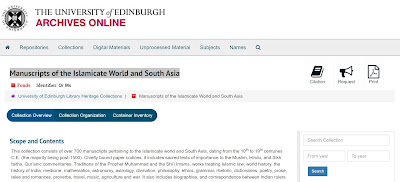
New OA Mss collection: Manuscripts of the Islamicate World and South Asia, University of Edinburgh


"Scope and Contents

This collection consists of over 700 manuscripts pertaining to the Islamicate world and South Asia, dating from the 10th to 19th centuries C.E. (the majority being post-1500). Chiefly bound paper codices, it includes sacred texts of importance to the Muslim, Hindu, and Sikh faiths, Qur’anic commentaries, Traditions of the Prophet Muhammad and the Shi’i Imams, works treating Islamic law, world history, the history of India, medicine, mathematics, astronomy, astrology, divination, philosophy, ethics, grammar, rhetoric, dictionaries, poetry, prose, tales and romances, proverbs, travel, music, agriculture and war. It also includes biographies, and correspondence between Indian rulers and dignitaries, and East India Company officials. 

Some of the collection’s manuscripts are among the most iconic items found at the University of Edinburgh Library, such as Qur’anic fragments in Kufic script on vellum, dating to around the 10th century (Os Ms 175), Rashīd al-Dīn’s Jamī al-Tawārīkh (Or Ms 20) and al-Bīrūnī's al-Āthār al-bāqiya (Or Ms 161), both richly illuminated examples of Islamic historiography dating to the 14th century C.E., and an 18th century Sanskrit scroll of the Hindu Mahābhārata featuring miniature illuminations and measuring over 70 metres (Or Ms 510). 

The grouping together of these items as one collection is the legacy of the route by which they reached the Library. It includes the vast majority of items formerly known as the "Oriental Collection"; the large donations that formed its basis were from the collections assembled by employees of the East India Company. This resulted in the collection incorporating material relevant to the Islamicate, largely gathered in South Asia, intertwined with items relevant to the Hindu and Sikh faiths, and the culture and history of South Asia more generally. The Turkish component of the collection includes manuscripts acquired in Astrakhan, with several early Ottoman texts. The items retain their "Or Ms" shelf mark to avoid creating a gap in the memory of their history. All catalogue records include the available provenance data. Research in this area is ongoing and such information will be expanded to include all details attesting the route of these items into the University of Edinburgh’s collections. 

Dates: 10th-19th centuries C.E. (bulk: post-1500 C.E.)

Language of Materials
Mainly in Persian and Arabic, but also Turkish, Sanskrit, Bengali, Hindustani, Malay, Panjabi, Prakrit, Syriac and Urdu.

Conditions Governing Access
Open. Please contact the repository in advance.
Extent

30 linear metres (approx)"

Manuscripts of the Islamicate World and South Asia: URL: https://archives.collections.ed.ac.uk/repositories/2/resources/86063 

Wednesday, June 23, 2021

Open Access ebook: Islam and Heritage in Europe


"Islam and Heritage in Europe provides a critical investigation of the role of Islam in Europe’s heritage. Focusing on Islam, heritage and Europe, it seeks to productively trouble all of these terms and throw new light on the relationships between them in various urban, national and transnational contexts.

Bringing together international scholars from a range of disciplines, this collection examines heritage-making and Islam in the context of current events in Europe, as well as analysing past developments and future possibilities. Presenting work based on ethnographic, historical and archival research, chapters are concerned with questions of diversity, mobility, decolonisation, translocality, restitution and belonging. By looking at diverse trajectories of people and things, this volume encompasses multiple perspectives on the relationship between Islam and heritage in Europe, including the ways in which it has played out and transformed against the backdrop of the ‘refugee crisis’ and other recent developments, such as debates on decolonising museums or the resurgence of nationalist sentiments.

Islam and Heritage in Europe discusses specific articulations of belonging and non-belonging, and the ways in which they create new avenues for re-thinking Islam and heritage in Europe. This ensures that the book will be of interest to academics, researchers and postgraduate students engaged in the study of heritage, museums, Islam, Europe, anthropology, archaeology and art history.

The Open Access version of this book, available at www.taylorfrancis.com, has been made available under a Creative Commons Attribution-ShareAlike 4.0 International (see also http://creativecommons.org/licenses/by-sa/4.0/)."

Islam and Heritage in Europe: https://www.taylorfrancis.com/books/oa-edit/10.4324/9781003044789/islam-heritage-europe-katarzyna-puzon-sharon-macdonald-mirjam-shatanawi 

Monday, March 1, 2021

OA Resource: Islamic Manuscript Conservation


"The Curriculum project:

The Curriculum Model, a collaborative project innitiated by Mandana Barkeshli, Paul Hepworth, and Karin Scheper, was developed to fill a void: Islamic manuscripts constitute a repository of enormous cultural and intellectual value and number in the millions; yet currently there are no educational programs which focus on their specific conservation issues.

Conservators of Islamic manuscripts currently face significant obstacles in order to get proper training. For many would-be conservators in Africa and Asia, educational opportunities may be limited whereas programs in North America and Europe are largely directed towards the conservation of western manuscripts. To address the need for an articulated and directed approach to Islamic manuscript conservation a curriculum model with this particular focus has been written for a two-year program of education. An extended introduction to the curriculum model can be found here.

The program, including a bibliography, can be downloaded here.

Development of the curriculum model was supported by the International Islamic University of Malaysia (IIUM) and The Islamic Manuscript Association (TIMA)."

Website: https://www.islamicmanuscriptconservation.org/index.html. 

Saturday, February 20, 2021

Open Access E-Book: Islam at 250; Studies in Memory of G.H.A. Juynboll

Islam at 250; Studies in Memory of G.H.A. Juynboll

Editors: Petra M. Sijpesteijn and Camilla Adang

Series: Leiden Studies in Islam and Society, Volume: 10

"Islam at 250: Studies in Memory of G.H.A. Juynboll is a collection of original articles on the state of Islamic sciences and Arabic culture in the early phases of their crystallization. It covers a wide range of intellectual activity in the first three centuries of Islam, such as the study of ḥadīth, the Qurʾān, Arabic language and literature, and history. Individually and taken together, the articles provide important new insights and make an important contribution to scholarship on early Islam. The authors, whose work reflects an affinity with Juynboll's research interests, are all experts in their fields. Pointing to the importance of interdisciplinary approaches and signalling lacunae, their contributions show how scholarship has advanced since Juynboll's days."

Contributors: Camilla Adang, Monique Bernards, Léon Buskens, Ahmed El Shamsy, Maribel Fierro, Aisha Geissinger, Geert Jan van Gelder, Claude Gilliot, Robert Gleave, Asma Hilali, Michael Lecker, Scott Lucas, Christopher Melchert, Pavel Pavlovitch, Petra M. Sijpesteijn, Roberto Tottoli, and Peter Webb.

ISBN: 978-90-04-42795-2

ISBN: 978-90-04-42794-5


Wednesday, January 6, 2021

OA Book: Fleeing from Fate to Fate: Aḥādīth on Contagion and Pandemics


A collection of 40 Ḥadīth related to the pandemic. Published by MT Karaan, Strand, Cape Town, South Africa. 

Book: https://www.yumpu.com/en/document/read/65163171/fleeing-from-fate-to-fatedocx

Wednesday, November 18, 2020

New OA Book: Muslim Women’s Pilgrimage to Mecca and Beyond Reconfiguring Gender, Religion, and Mobility


Muslim Women’s Pilgrimage to Mecca and Beyond
Reconfiguring Gender, Religion, and Mobility

Edited By: Marjo Buitelaar, Manja Stephan-Emmrich, Viola Thimm

Edition1st Edition
First Published2020
eBook Published15 November 2020
Pub. location London
Imprint Routledge
DOIhttps://doi.org/10.4324/9781003110903
Pages222 pages
eBook ISBN9781003110903

This book investigates female Muslims pilgrimage practices and how these relate to women’s mobility, social relations, identities, and the power structures that shape women’s lives. Bringing together scholars from different disciplines and regional expertise, it offers in-depth investigation of the gendered dimensions of Muslim pilgrimage and the life-worlds of female pilgrims. With a variety of case studies, the contributors explore the experiences of female pilgrims to Mecca and other pilgrimage sites, and how these are embedded in historical and current contexts of globalisation and transnational mobility. This volume will be relevant to a broad audience of researchers across pilgrimage, gender, religious, and Islamic studies.

Link 


Friday, October 25, 2019

Open Access Textbook: A Critical Introduction to Islamic Legal Theory


Title: A Critical Introduction to Islamic Legal Theory
Author: Vishanoff, David R.

"This open access textbook by David Vishanoff offers to students and scholars interested in the Islamic discipline of legal theory (uṣūl al-fiqh) a critical Arabic edition and an English translation of Imām al-Ḥaramayn al-Juwaynī’s Leaflet on the Sources of Law (Kitāb al-Waraqāt fī uṣūl al-fiqh), along with a new explanatory commentary on the text and a method for readers to add their own comments to any page, paragraph, or phrase. Unlike the many traditional commentaries that have been written on al‑Juwaynī’s popular medieval handbook https://waraqat.vishanoff.com, David Vishanoff’s extensive commentary explains for uninitiated modern English-speaking readers the function and significance of each legal theory principle, and critically examines the conceptions of ethics, knowledge, and scriptural interpretation that are articulated or assumed in this classic summary of Islamic legal theory."

BOOK CONTENTS

Tuesday, April 10, 2018

Mediterranea: International Journal on the Transfer of Knowledge


https://www.uco.es/ucopress/ojs/index.php/mediterranea/issue/archive

Publisher: UCOPress. Cordoba University Press (UCOPress Editorial Universidad de Córdoba) ISSN: 2445-2378

Mediterranea is an international journal focusing on various areas of knowledge transfer from Late Antiquity to the Early Modern period, covering the Middle East and the Mediterranean basin, and paying special attention to philological, philosophical, scientific, cultural and religious fields of research. Mediterranea publishes original papers relating to all aspects of the knowledge transfer from Late Antiquity to the Early Modern period. All submissions from Arts and Humanities, Cultural Heritage, Social Sciences and Experimental Sciences are welcome.

URL

Alphabetical List of Open Access Journals in Middle Eastern Studies

Tuesday, September 6, 2016

Open Access Exhibition Catalogue: Power and Piety: Islamic Talismans on the Battlefield at the Met Museum

Exhibition Overview

Inscriptions and images on Islamic arms and armor were believed to provide their wearers with safety and success in combat. This exhibition, featuring some 30 works from The Met collection, examines the role of text and image in the construction and function of arms and armor in the Islamic world. Qur'anic verses; prayers that invoke Allah, the Asma al-Husna (Ninety-nine Beautiful Names of Allah), as well as the Prophet Muhammad, his family, and companions; and mystical symbols were all used to imbue military apparel, weapons, and paraphernalia with protective powers.


Power and Piety: Islamic Talismans on the Battlefield at the Met Museum

Tuesday, January 26, 2016

AlKindi, the online catalogue of the Dominican Institute for Oriental Studies, Cairo

AlKindi, the online catalogue of the Dominican Institute for Oriental Studies, Cairo

AlKindi 4, Ideo Library - Cairo

IDEO’s library is one of the prominent libraries specialised in Islamic studies in the world. It is opened to all. Our library gathers over 125,000 monographs and nearly 1,800 journals and periodicals. It intends to cover all disciplines in Islamic studies: Arabic language, Quranic exegesis, theology, law and jurisprudence, history, philosophy, sufism, history of sciences. It provides more than 20,000 classical texts of the Arabic and Islamic heritage, and secondary literature in Arabic and European languages. Many PhD dissertations are also available.

AlKindi 4 and FRBR

We are glad to introduce the new version of AlKindi, genuinely complying with the conceptual model approved by the International Federation of Library Association (IFLA) called FRBR (which stands for Functional requirements for Bibliographic Records).
FRBR specifies four levels of information. Each level can be connected to a specific responsibility. You are already familiar with two of these four levels:
  • The item, the lower level: it is the document you actually have in hands. It is identified by its call number. Examples of reponsibilities include: a donor, a binder, or a former owner.
  • The manifestation: it refers to a specific publication. It is identified by ISBN/ISSN. Examples of responsibilities include: a publisher, a manufacturer, or a copyright owner.
To those long-established levels, FRBR adds two new more abstract levels:
  • The expression: it refers to a specific edition. It is typically identified by a language. Examples of responsibilities include: an intellectual editor, a translator, or an illustrator.
  • The work, the higher level: it refers to the intellectual production in itself. It is identified by its title. Examples of responsibilities include: an author, a compiler, or an addressee.
The new features of AlKindi 4, based on FRBR, make it easier to display the different editions or translations of a given work (its publication history), or to distinguish the different responsibilities of a given authority.
Each of these four levels can be connected to an authority and to another record of the same level.
  • At the work level, it enables the display of the historical and cultural context of a work. Examples of relationships include: commentaries, refutations, summaries, or compilations.
  • At the manifestation level, it enables the display of the publishing context of a manifestation. Examples of relationships include: reprints, offprints, piece-analytics, or accompanying materials.
Lastly, authorities themselves can be connected to one another, it enables the display of family and academic relationships. Examples of relationships include: son, father, disciple, or master.
⬛ Welcome
Warnings
How to display special characters?
Thanks
Latest acquisitions
Latest analytic pieces
Classification
Links
Access

Friday, November 27, 2015

New Open Access Journal: Hadīth and Sīra Studies

Hadīth and Sīra Studies
http://magazine.hadithandsira.info/wp-content/uploads/2015/10/logo.png
The mission to understand Prophet Muhammad and present his message to the world based on primary sources, which Meridyen Association began in 2007 with the launch of the LastProphet.info web portal, is now expanding to a new field.

A peer-reviewed academic journal, Hadīth and Sīra Studies, is the next step in a line of academic activities that include “The Hadīth and Sīra Research Awards”, “Sīra Workshop” and “International Sīra Studies Symposium” conducted under the Lastprophet.info project. With the focus of gathering academic research of the Prophet Muhammad’s life to reveal universal guiding principles applicable to both Muslims and non-Muslims alike, this biannual journal seeks to make a meaningful contribution to the field of hadīth and sīra studies.

Hadīth and Sīra Studies recognizes the rigorous intellectual standards set by Western academia and aims to adhere to them from its first issue as part of its long-term goal to become a leading international publication. In line with its interdisciplinary perspective, Hadīth and Sīra Studies welcomes contributions from diverse fields of research.

How primary Islamic sources have been understood and interpreted throughout history shapes the way they are understood by the present generation. It is therefore necessary to both convey the Islamic tradition through a re-evaluation and analysis of the literature written during previous centuries, and to make it relevant to contemporary problems. The critical and philosophical ideas voiced since the 18th century in both the East and West cannot be ignored and must be engaged with by hadīth and sīra studies. Classical Islamic texts should be reread and at the same time rediscovered in light of these intellectual developments. In tackling these significant issues, the importance of adopting both an international and interdisciplinary approach becomes clear. At this current time, Hadīth and Sīra Studies intends to publish articles in Arabic, English, German and French in addition to Turkish.

We welcome your academic contributions addressing the separate or common issues of hadīth and sīra studies, as well as those connecting them to relevant disciplines, for our second issue which will be published in May 2016.

Deadline for submissions: 15th March 2016

Volume:1 Issue:1 Autumn 2015

Sunday, September 27, 2015

Open Access Quranic Arabic Corpus

 [First posted in AMIR 11 August 2011,  updated 27 September 2015]

Quranic Arabic Corpus
http://corpus.quran.com/images/logo.png
Welcome to the Quranic Arabic Corpus, an annotated linguistic resource which shows the Arabic grammar, syntax and morphology for each word in the Holy Quran. The corpus provides three levels of analysis: morphological annotation, a syntactic treebank and a semantic ontology.
  • Version 0.4 Released - new and updated linguistic features in this version of the corpus
  • Word by Word Quran - maps out the syntax of the entire Quran, with analysis and translation
  • Quranic Grammar - traditional Arabic grammar (إعراب) illustrated using dependency graphs

Wednesday, April 22, 2015

New OA Encyclopedia: Dāʼirat al-maʻārif-i buzurg-i Islāmī

Published in Tihrān at the Markaz-i Dāʼirat al-Maʻārif-i buzurg-i Islām, this encyclopedia has recently been released electronically.

Site: http://www.cgie.org.ir/fa/publication/volumes/63 


Monday, April 6, 2015

Open Access Journal: Kafa`ah: Journal of Gender Studies

Kafa`ah: Journal of Gender Studies
Print ISSN: 2356-0894
Online ISSN: 2356-0630
http://www.kafaah.org/public/journals/1/pageHeaderTitleImage_en_US.png
Kafa’ah (Print ISSN 2356-0894 Online ISSN 2356-0630) is an open-access and peer reviewed journal published by Center for Gender and Child Studies, State Institute of Islamic Studies (IAIN) Imam Bonjol Padang. This journal covers key issues on gender studies, including: place of women in society, empowering women, and government policies on women empowerment. The objective of the journal is to promote the sharing of knowledge and understanding on the gender issues. It then welcomes contributions from experts, researchers, practitioners, and policy makers around the world. This journal is published twice a year.


2011


Thursday, March 26, 2015

The Clarion Project: Challenging Extremism, Promoting Dialogue

The Clarion Project: Challenging Extremism, Promoting Dialogue
 The Clarion Project
Founded in 2006, Clarion Project (formerly Clarion Fund Inc) is an independently funded, non-profit organization dedicated to exposing the dangers of Islamic extremism while providing a platform for the voices of moderation and promoting grassroots activism. 

Clarion’s award-winning movies have been seen by over 50 million people. They grapple with issues such as religious persecution, human rights, women’s rights, the dangers of a nuclear Iran and what the concept of jihad means for the West. Our dynamic website, viewed by 1.1 million unique visitors in 2014, covers breaking news, provides expert analysis on relevant issues and acts as a platform for Muslim human rights activists. 

Clarion Project draws together Middle East experts, scholars, human rights activists and Muslims to promote tolerance and moderation and challenge extremism.

The Clarion Project archives scans of Dabiq: The Islamic State's (ISIS) Magazine

Monday, February 16, 2015

al-Thurayyā Gazetteer, Ver. 02

al-Thurayyā Gazetteer, Ver. 02
http://maximromanov.github.io/images/althurayya_02_01.png
This is our first usable demo of al-Thurayyā Gazetteer. Currently it includes over 2,000 toponyms and almost as many route sections georeferenced from Georgette Cornu’s Atlas du monde arabo-islamique à l'époque classique: IXe-Xe siècles (Leiden: Brill, 1983). The gazetteer is searchable (upper left corner), although English equivalents are not yet included; in other words, look for Dimashq/دمشق, not Damascus.

You can browse the Gazetteer by clicking on any toponym marker. The popup will show the toponym both in Arabic script and transliterated. We are using a slightly modified transliteration system that facilitates conversion between fully transliterated, transliterated, and Arabic forms of toponyms. It should be easily understandable. There may be typos, because of the nature of how the data has been generated, so please, let us know if something should be corrected. The popup also offers a selection of possible sources on a toponym in question. You can check Arabic Sources: currently, al-Samʿānī’s Kitāb al-ansāb and Yāqūt’s Muʿjam al-buldān. Currently, the Gazetteer will only check for exact matches, which means that in some cases there will not be any entry at all, while in other cases there may be more than one and they may refer to other places with the same name. Improving the precision of this lookup is on our to-do list. You can also check if there is information on a toponym in question in Brill's Encyclopaedia of Islam, Pleiades, and Wikipedia.

Credits & Acknowledgments

Many thanks to Adam Tavares (programmer @ Perseus Project, Tufts) and, particularly, Cameron Jackson (senior, double-majoring in Arabic and Computer Science, Tufts) for the technical development; to Vickie Sullivan (Chair, Classics Department), Gregory Crane and the entire Perseus team on the both sides of the Atlantic for support and inspiration.

Thursday, February 12, 2015

New Open Access Journal: International Journal of Nusantara Islam

International Journal of Nusantara Islam
ISSN: 2355-651X (online)
ISSN: 2252-5904 (print)

http://journal.uinsgd.ac.id/public/journals/1/homeHeaderTitleImage_en_US.png
International Journal of Nusantara Islam is focused on Islamic studies related to its teachings resources, thoughts, history, law, politics, economics, education, culture, Islamic propagation, communication, psychology, and science and technology available in the Nusantara territories i.e. Indonesia, Malaysia, Brunei Darussalam, Singapore, Thailand, the Philippines, and Timor Leste. This journal also covers contemporary Islamic issues emerging in the Nusantara territories or countries.
International Journal of Nusantara Islam invites and appreciates writers who write any Arabic or English scientific work in the form of both research report and significant opinion on Islamic studies and issues mentioned above. Any work published in this journal does not represent this journal editorial board‟s opinion and perspective, but merely its writer‟s findings and thought. For this reason, it is essential that the writer be fully responsible for whatever he or she wrote.

2014

Vol 2, No 1 (2014): International Journal of Nusantara Islam

In relation to the existing situation, we, the editorial board of International Journal of Nusantara Islam, are aware of the importance of Islamic sciences in order to perceive and criticize what is happening and changing among the communities. Then, we make every possible effort to extrapolate any Islamic theory and concept concerning fiqh (Islamic jurisprudence), tarbiyah (education), kalam (Islamic theology), philosophy and the like with the intention of following changes that happens rapidly.

2013

Vol 1, No 2 (2013): International Journal Of Nusantara Islam

In relation to the existing situation, we, the editorial board of International Journal of Nusantara Islam, are aware of the importance of Islamic sciences in order to perceive and criticize what is happening and changing among the communities. Then, we make every possible effort to extrapolate any Islamic theory and concept concerning fiqh (Islamic jurisprudence), tarbiyah (education), kalam (Islamic theology), philosophy and the like with the intention of following changes that happens rapidly.

Tuesday, February 3, 2015

Open Access Journal: Mahjubah

Mahjubah
Mahjubah is a cultural, social and family magazine for women that is published monthly in English.

The main topics covered by this magazine are:
1)      Presenting a comprehensive model of women’s character and position;
2)      Opposing deviations as well as misinterpretations of the status and position of women;
3)      Stating the rights and duties of women towards creating a healthy human community;
4)      Introducing the Islamic legal system regarding the rights of women and families;
5)      Clarifying the foundations of the family and comparing external realities with the constructive and moral teachings of Islam in this regard.
Volume 26 (2014)
Volume 25 (2012) 
Volume 24 (2011)