Showing posts with label Arabic. Show all posts

Wednesday, December 18, 2024

OA Journal: The Arabist: Budapest Studies in Arabic


"A double-blind peer-reviewed journal in the field of Arabic and Islamic studies, founded in 1988.

ISSN: 0239-1619

Founding Editor: Alexander Fodor (1941-2014)

Editor-in-Chief: Kinga Dévényi

Editors:

Antonella Ghersetti 

Anne Regourd

Avihai Shivtiel

Review Editor: Tamás Iványi

Publisher: Eötvös Loránd University Chair of Arabic Studies & Csoma de Kőrös Society Section of Islamic Studies

For enquiries and submission of articles to the journal please write to arabist@korosicsomatarsasag.hu"

URL: https://arabist.hu/


Monday, November 13, 2023

Audition Certificates Platform Search for names, places and any term in audition certificates. ACP uses Arabic script only, no Latin transliteration.


"Unlocking the transmission archive in Arabic manuscript cultures

Audition certificates (سماع, طبقة السماع or إجازة) are a salient feature of Arabic manuscript cultures. They are notes written on a book to document the authorised transmission of the book’s text from teacher(s) to student(s). In concrete terms, the text was read out aloud (by the teacher or one of the students) and at the end of the reading session one of the members of this reading group added the audition certificate to the book. By virtue of their participation all students now had the right to act as teacher in future reading sessions.

Audition certificates are brimming with data and can include: the name of the teacher(s), the name of the student(s) (including highlighting those coming late or leaving early), the name of the reader, the name of the writer of the certificate, the name of the book’s owner, the date of the reading, the place of the reading and many other surprises (such as a writer recording the birth of his son during the reading session in the room next door). These certificates contain a wealth of historical data, in particular on persons we do not find in many other sources such as women and slaves. They are thus a source of outstanding importance for fields such as social history, history of ideas, economic history, urban history, historical topography, and biographical studies. It goes without saying that, especially in a comparative perspective with other world regions, such as Latin Europe, this copious material represents a considerable resource for widening our understanding of Middle Eastern societies. 

So far, the field of Middle Eastern history has used this unparalleled source for medieval history only for individual manuscripts or small corpora. The problem is simply that audition certificates are distributed in tens of thousands of manuscripts around the globe and that no systematic project to make them available was ever started. The farthest we got was a collaborative project between German and Syrian colleagues who published in facsimile a selection of certificates from the National Syrian Library in Damascus and provided them with an enormous index:

Stefan Leder/Yāsīn Muḥammad al-Sawwās/Maʾmūn al-Ṣāġarjī, Muʿjam al-samāʿāt al-Dimashqīya. Les certificats d’audition à Damas. 550-750/1155-1349, Damascus 1996 and Stefan Leder/Yāsīn Muḥammad al-Sawwās/Maʾmūn al-Ṣāġarjī, Muʿjam al-samāʿāt al-Dimashqīya - ṣūwar al-makhṭūṭāt. Recueil de documents fac-similés des certificats d’audition à Damas. 550-750/1155-1349, Damascus 2000

ACP is the first major project aimed at unlocking the potential of this unique source corpus.  We have started to go through the holdings of selected libraries (Staatsbibliothek Berlin, Forschungsbibliothek Gotha, The Bibliothèque nationale de France, Syrian National Library), but we cannot claim to have identified all audition certificates in the manuscript books on their shelves. We will continue to go through further collections to enlarge this first large-scale and fully searchable corpus of audition certificates. 

The data set underlying ACP is available as open access publication stored in the Research Data Repository at Universität Hamburg, https://www.fdr.uni-hamburg.de/record/13525. The data set is published under a CC BY 4.0 license allowing it to be reused for other projects. ACP will be updated periodically with consecutively numbered new versions. The current version 1.0  was published 26.10.2023.

 Audition certificates are the result of complex documentary practices and they were written by highly specialised communities. We have only started to understand many of the scribal practices, documentary logics and archival practices that shaped the various forms of certificates in different places and in different periods. The following list provides some background in order to understand the wider historical context of the certificates and the practices that shaped them:

 سعید ضامن الجومانيدلالات المصطلحات الواردة في مجالس السماع والقراءة في المخطوطات العربية

Journal of Islamic Manuscripts 11 (2020) 106-132.

سعید ضامن الجومانيوثيقة جديدة عن نقل العِلم في التاريخ الإسلامي. تحقيق أوراق السّماع لسنن الدّارقطني, مجلة كلية الشريعة والدراسات الإسلامي 38-2 [2021], 19ـ75.

Davidson, Garrett: Carrying on the Tradition: A Social and Intellectual History of Hadith Transmission Across a Millennium, Leiden 2020.

Hirschler, Konrad: A Monument to Medieval Syrian Book Culture: The Library of Ibn ʿAbd al-Hādī, Edinburgh 2020.

سعید ضامن الجومانيصور الإجازات المنقولة في المخطوطات العربية: السبب، والوظيفة

Journal of Islamic Manuscripts 9 (2018) 72-100.

Andreas Görke/Konrad Hirschler (eds), Manuscript Notes as Documentary Sources, Würzburg 2011.

Stefan Leder/Yāsīn Muḥammad al-Sawwās/Maʾmūn al-Ṣāġarjī, Muʿjam al-samāʿāt al-Dimashqīya. Les certificats d’audition à Damas. 550-750/1155-1349, Damascus 1996.

Stefan Leder/Yāsīn Muḥammad al-Sawwās/Maʾmūn al-Ṣāġarjī, Muʿjam al-samāʿāt al-Dimashqīya - ṣūwar al-makhṭūṭāt. Recueil de documents fac-similés des certificats d’audition à Damas. 550-750/1155-1349, Damascus 2000.

Leder, Stefan: ‘Hörerzertifikate als Dokumente für die islamische Lehrkultur des Mittelalters’, in R. Khoury (ed.), Urkunden und Urkundenformulare im klassischen Altertum und in den orientalischen Kulturen, Heidelberg 1999, 147-66. 

Leder, Stefan: ‘Eine neue Quelle zur Stadtgeschichte von Damaskus. Zur Alltagsgeschichte der Ḥadīthwissenschaft’, in H. Preissler (ed.), Annäherung an das Fremde, Stuttgart 1998, 268-79.

صلاح الدين المنجدإجازة السماع في المخطوطات القديمة, مجلة معهد المخطوطات العربية 1 (1955), 51-232."

Audition Certificates Platform URL: https://www.audition-certificates-platform.org/. 


Wednesday, September 28, 2022

New OA Mss collection: Manuscripts of the Islamicate World and South Asia, University of Edinburgh


"Scope and Contents

This collection consists of over 700 manuscripts pertaining to the Islamicate world and South Asia, dating from the 10th to 19th centuries C.E. (the majority being post-1500). Chiefly bound paper codices, it includes sacred texts of importance to the Muslim, Hindu, and Sikh faiths, Qur’anic commentaries, Traditions of the Prophet Muhammad and the Shi’i Imams, works treating Islamic law, world history, the history of India, medicine, mathematics, astronomy, astrology, divination, philosophy, ethics, grammar, rhetoric, dictionaries, poetry, prose, tales and romances, proverbs, travel, music, agriculture and war. It also includes biographies, and correspondence between Indian rulers and dignitaries, and East India Company officials. 

Some of the collection’s manuscripts are among the most iconic items found at the University of Edinburgh Library, such as Qur’anic fragments in Kufic script on vellum, dating to around the 10th century (Os Ms 175), Rashīd al-Dīn’s Jamī al-Tawārīkh (Or Ms 20) and al-Bīrūnī's al-Āthār al-bāqiya (Or Ms 161), both richly illuminated examples of Islamic historiography dating to the 14th century C.E., and an 18th century Sanskrit scroll of the Hindu Mahābhārata featuring miniature illuminations and measuring over 70 metres (Or Ms 510). 

The grouping together of these items as one collection is the legacy of the route by which they reached the Library. It includes the vast majority of items formerly known as the "Oriental Collection"; the large donations that formed its basis were from the collections assembled by employees of the East India Company. This resulted in the collection incorporating material relevant to the Islamicate, largely gathered in South Asia, intertwined with items relevant to the Hindu and Sikh faiths, and the culture and history of South Asia more generally. The Turkish component of the collection includes manuscripts acquired in Astrakhan, with several early Ottoman texts. The items retain their "Or Ms" shelf mark to avoid creating a gap in the memory of their history. All catalogue records include the available provenance data. Research in this area is ongoing and such information will be expanded to include all details attesting the route of these items into the University of Edinburgh’s collections. 

Dates: 10th-19th centuries C.E. (bulk: post-1500 C.E.)

Language of Materials
Mainly in Persian and Arabic, but also Turkish, Sanskrit, Bengali, Hindustani, Malay, Panjabi, Prakrit, Syriac and Urdu.

Conditions Governing Access
Open. Please contact the repository in advance.
Extent

30 linear metres (approx)"

Manuscripts of the Islamicate World and South Asia: URL: https://archives.collections.ed.ac.uk/repositories/2/resources/86063 

Monday, August 1, 2022

OA Journal: رسلة المشرق (Risālat al-Mashriq)


Journal title: رسلة المشرق (Risālat al-Mashriq)

Published by: مركز الدراسات الشرقية: جامعة القاهرة (Centre for Oriental Studies, Cairo University)

Frequency: 1 issue per year. 

Articles published in Arabic. 


"تهدف المجلة لنشر الوعي بين الباحثين والشباب بالحضارة والتراث والآداب واللغات الشرقية وآدابها والتعريف بالمجتمعات التي تتحدث بهذه اللغات. تتميز المجلة بالجدية والأصالة ومواکبة المتغيرات والأحداث المرتبطة بالدراسات الشرقية (أدبية، لغوية، سياسية، اجتماعية، تاريخية، فلسفية)." 

URL: https://rmshreq.journals.ekb.eg/issue_13231_13271_.html


Monday, September 13, 2021

New OA book: A Handbook and Reader of Ottoman Arabic


"Written forms of Arabic composed during the era of the Ottoman Empire present an immensely fruitful linguistic topic. Extant texts display a proximity to the vernacular that cannot be encountered in any other surviving historical Arabic material, and thus provide unprecedented access to Arabic language history.

This rich material remains very little explored. Traditionally, scholarship on Arabic has focussed overwhelmingly on the literature of the various Golden Ages between the 8th and 13th centuries, whereas texts from the 15th century onwards have often been viewed as corrupted and not worthy of study. The lack of interest in Ottoman Arabic culture and literacy left these sources almost completely neglected in university courses.

This volume is the first linguistic work to focus exclusively on varieties of Christian, Jewish and Muslim Arabic in the Ottoman Empire of the 15th to the 20th centuries, and present Ottoman Arabic material in a didactic and easily accessible way. Split into a Handbook and a Reader section, the book provides a historical introduction to Ottoman literacy, translation studies, vernacularisation processes, language policy and linguistic pluralism. The second part contains excerpts from more than forty sources, edited and translated by a diverse network of scholars.

The material presented includes a large number of yet unedited texts, such as Christian Arabic letters from the Prize Paper collections, mercantile correspondence and notebooks found in the Library of Gotha, and Garshuni texts from archives of Syriac patriarchs."

A Handbook and Reader of Ottoman Arabic
Esther-Miriam Wagner (ed.) | September 2021
488pp. | 4 B&W or colour illustration | 6.14" x 9.21" (234 x 156 mm)
Semitic Languages and Cultures | ISSN: 2632-6906 (Print); 2632-6914 (Online)ISBN Paperback: 9781783749416
ISBN Hardback: 9781783749423
ISBN Digital (PDF): 9781783749430

DOI: 10.11647/OBP.0208
Subject Codes: BIC: CFF (Historical and comparative linguistics), CFP (Translation and interpretation); BISAC: REL006020 (RELIGION / Biblical Biography / General), LAN009010 (LANGUAGE ARTS & DISCIPLINES / Linguistics / Historical & Comparative)

Link: https://www.openbookpublishers.com/product/1168

Saturday, March 27, 2021

New OA Book: Practices of Commentary


Congratulations to Christina Lechtermann and Markus Stock on the publication of their volume, “Practices of Commentary,” published in the Zeitsprünge series. This book arose out of a conference held at the Goethe Universität Frankfurt am Main, in December 2018, where scholars from both the University of Toronto and the Goethe University convened to consider the boundaries of commentary. The introductory chapter of this volume (by Christina Lechtermann and Markus Stock) presents a number of questions about the nature of commentary and leads into a series of premodern case studies in the fields of Arabic, English, German, Jewish, Latin, and Romance studies. Read the text in full below.

A hearty congratulations also to the contributors of this volume, many of whom are currently involved with the Global Commentary project:
Stefanie Brinkmann, “Marginal Commentaries in Ḥadīṯ Manuscripts.”
Walid Saleh, “The Place of the Medieval in Qur’an Commentary: A Survey of Recent Editions.”
Jeannie Miller, “Commentary and Text Organization in al-Jāḥiẓ’s Book of Animals.”
Suzanne Akbari, “Ekphrasis and Commentary in Walter of Chatillon’s Alexandreis.”
Jennifer Gerber, “About Form and Function of German Vernacular Commentaries.”
Christina Lechtermann, “Commentary as Literature: The Medieval ‘Glossenlied.'”
Philip Stockbrugger, “Mirroring Authorization in Torquato Tasso’s Rime Amorose.”

URL: https://globalcommentary.utoronto.ca/?p=654. Direct download of the book: https://globalcommentary.utoronto.ca/wp-content/uploads/2021/03/Practices-of-Commentary-Zeitspru%CC%88nge-Forschungen-zur-Fru%CC%88hen-Neuzeit.pdf.

Wednesday, March 17, 2021

OA Journal: Y'ALLA A Texan Journal of Middle Eastern Literature


"Y’alla

The first issue of Y’alla will go live later this year. In the meantime, please send us your poems, stories, essays, and novel excerpts translated from Persian, Hebrew, Turkish, Arabic or any other language pertaining to the Middle East and North Africa. You can submit your work directly at dena.afrasiabi@austin.utexas.edu. Please email queries and questions."


Website: https://sites.utexas.edu/yalla/

Tuesday, December 29, 2020

جرائد Jara'id : A Chronology of Nineteenth Century Periodicals in Arabic (1800-1900): A Research Tool

[First posted in AMIR1 September 2012, updated (New URLs) 29 December 2020]

جرائد Jara'id : A Chronology of Nineteenth Century Periodicals in Arabic (1800-1900): A Research Tool
2020 Edition 
Contributions from Hala Auji, Philippe Chevrant, Marina Demetriadou, Lamia Eid, Stacy Fahrenthold, Till Grallert, Rana Issa, Nicole Khayat, Peter Magierski, Leyla von Mende, Adam Mestyan, Christian Meier, Daniel Newman, Geoffrey Roper, Sinai Rusinek, Philip Sadgrove, Ola Seif, and Rogier Visser
Prepared and supervised by Adam Mestyan 
Original 2012 Edition TEI XML-Markup, digital publication, concept and design of the website by Till Grallert 
2020 Edition: Data addition, CETEICean transformation, digital publication, and design of the website by Adam Mestyan and Till Grallert; 
XSLT by Hugh Cayless and Till Grallert 
Advisor to 2020 Edition (CETEICean, JS, XSLT): Hugh Cayless 
Advisor to 2020 Edition (Visualization): Eric Monson 
This database and website are under the Creative Commons copyright of Attribution-NonCommercial 4.0 International (CC BY-NC 4.0) 
This website uses CETEICEan by Hugh Cayless and Raffaele Viglianti to display the umodified TEI file in HTML 
Introductory Notes 
This website provides a chronology of Arabic periodicals between 1800 and 1929. 
Although it is meant to include all periodicals published in Arabic or in Arabic and in another language (such as the usual pair of Arabic and Ottoman Turkish) or in Arabic written in a different script (such as Judeo-Arabic) during the period from 1800 to 1929, this chronology is certainly incomplete.  Furthermore, there remain numerous problems with dating and locating individual publications as well as identifying their owners, editors, or publishers. 
Thus, at the moment we consciously publish a working draft with the purpose of making our information available to the scholarly community. We welcome all readers to submit any comment, corrections, and new data using Adam Mestyan's official email address. We would like to ask all contributors to always refer to the ID of each title – in case of comments on existing entries – and cite their sources, as otherwise we cannot consider the submission for being included in the table. Every contribution will be acknowledged. 
We chose to present the core data as a table containing information on titles, dates of first and last issue published, place(s) of publication, names of publishers and editors, language(s) of publication, and available collections (so far only in English/transliteration but Arabic indexes are coming as well). In addition, we provide various indexes of holding institutions and locations, as well as a bibliography of the most important secondary sources and available union catalogues. To search any part of the website, simply the browser's search function should be invoked (Ctrl-F for Windows, Cmd-F for Mac OSX). 


Monday, November 2, 2020

New OA resource: al-sharekh archive


"AlSharekh Archive: 228 Arabic journals, 277,000 articles by 46,281 writers 

Access to the archive is open to all via the AlSharekh Archive website https://archive.alsharekh.org 

AlSharekh Archive from Sakhr, is one of the most distinguished Arabic digitization initiatives. It is the first and only one to focus on the content of literary journals providing online access to the content of 228 Arabic literary journals, from 23 Arab countries, dating from the early Arab renaissance (al Nahda) in the mid-nineteenth century to the end of the twenty-first century. 

Among the journals are Arab renaissance journals such as Al-Muqtataf, Al-Muqtabas, Al-Hilal, Al-Adib, Al-Ustadh, Al-Mashriq, Al-Jamaa and others. Authors of the journal articles include prominent Arab writers such as Gerji Zidan, Taha Hussein, Yaqub Sarrouf, Hafez Ibrahim, Albert Adeeb and many others. 

The AlSharekh Archive s’ site is very easy to use and navigate. Users can browse the journal issues or search the metadata indexes of the articles. Journal articles are viewed as images and have not been converted into digital texts because of difficulties in Arabic OCR. 

Some characteristics of the Archive: 

● It is the first Arabic digital library focusing on literary journals. Most of the others mostly cover resources related to Islamic heritage. 

● The website and the content are accessible free of charge. Access is provided to more than a million pages of Arabic literary work, otherwise hidden on bookshelves. 

● The journals are listed on the site according to the country of publishing, which helps in documenting the publishing movement at the country level. 

● Journal issues are organized and displayed in chronological order making it easy to access the specified number and the required article. 

● The Table of Content in each issue of a journal provides links to the pdf of the articles on the list. 

● Articles are accessed in their original form as in the print issues. 

● The search box on the site allows searching by the article’s author, title ,and by the title of the journal. 

● Brief author biographies, and bibliographic information about the journals are also provided. 

Procedures to protect copyright are mentioned in the preamble on the first page of the Archives website. It should be noted that many journals in the Archives are outdated and not subject to intellectual property law. 

Fatme Charafeddine, American University of Beirut"

Sunday, August 2, 2020

Open Access Newspaper Archive - Arabic Periodicals (Digitization Project "Translatio")

Digitization Project "Translatio"  from the Universitäts- und Landesbibliothek Bonn makes available digital copies of Persian, Arabic, and Turkish periodicals.
Each title has a WorldCat record, albeit in German transliteration, with link to digitized content. For each entry there is a Wikipedia page in German, Arabic and other languages, presumably created by the Translatio project. Wikipedia entries include references to other sources. Single volumes of the newspapers are downloadable.

See also: A Chronology of Arabic, Persian and Ottoman-Turkish Periodicals

In addition to listing the individual titles on the A-Z list of historical newspapers AMIR editors are providing variant spelling of the titles to improve discovery of these archives on the web.
Suggestions/corrections are welcome as always.

23 Arabic titles, some from reprints.

الادب والفن =  al-Ādāb wa-al-Fann = al- adab wal-fann = Literature and art  1943-1945
 اپولو = Apūllū = Abūlū = Apollo 1932-1934
البلاغ الاسبوعی = al-Balāgh al-usbūʻī = al- balāġ al-usbūʻī 1926-1930
‏البيان‎ = al-Bayān = al-bayān 1897-1898
مجلة كلية الآداب بالجامعة فاروق الأول = Majallat Kullīyat al-Ādāb =
Bulletin of the Faculty of Arts 1943-1957
مجلة كلية الآداب بالجامعة المصرية = Majallat Kullīyat al-Ādāb bi-al-Jāmiʻah al-Miṣrīyah =
Bulletin of the Faculty of Arts of the University of Egypt 1933-1935
الضياء‎ = al-Ḍiyāʼ = ad-ḍīyāʻ 1898-1906
 الدنيا المصوّرة = al-Dunyā al-muṣawwarah = ad-dunya 'l-muṣauwara  1929-1932
الفجر = al-Fajr = al-Faǧr 1934-1935
الفجر = al-Fajr = al-Faǧr 1921-1922
 الفكاهة = al-Fukāhah = al-Fukāha 1926-1933
 الحرىة = al-Ḥurrīyah = al-Ḥurrı̄ya 1924/25
العرفان‎ = al-'Irfān 1910-1946
الجامعة‎ = al-Jāmiʻah = al-Jamyat = al-Jāmiʻah al-ʻUthmānīyah = al-Ǧāmiʻa al-ʻuṭmānīya = al-Ǧāmiʻa 1899-1910
 الكاتب المصري = al-Kātib al-Miṣrī 1946-1948
المعرفة = al-Maʻrifah = Maarefa = al-Maʻrifa 1931-1934
النبراس = al-Nibrās = an-Nibrās 1909-1910
المقتطف = al-Muqtaṭaf = al-Muktataf 1876-1952
الراوي = al-Rāwī = ar-Rāwī 1889-1890
 صحيفة دار العلوم =  Ṣaḥīfat Dār al-ʻUlūm fī al-ʻilm wa al-adab wa al-ijtimāʻ.
 = Ṣaḥīfat Dār al-ʻUlūm 1934-1948
الطبيب‎ =  al-Ṭabīb = aṭ-Ṭabīb 1884/85
التهذيب = al-Tahdhīb = at-Tahd̲īb  1902-1903
الزهور = al-Zuhūr = az-Zouhour = az-Zuhūr  1910-1913

Tuesday, July 21, 2020

New Open Access Journal: LAMMA: A JOURNAL OF LIBYAN STUDIES


لمّة: هي مجلة دراسات ليبية تهدف الى توفير منصة (منتدى) يتم من خلاله طرح ومناقشة الأفكار والقيم والتكوينات الاجتماعية والتاريخ والواقع الحالي لليبيا بأسلوب نقدي يهدف الى فهمها بصورة أوضح

ولعلمنا بأهمية مثل هذا المنتدى والحاجة المُلحّة له، سنولي الاهتمام الى نطاق واسع ومجموعة كبيرة من التخصصات والمصادر والمناهج معطين الأولوية الى تلك الموضوعات التي لم تلق الاهتمام اللازم من قبل الباحثين سابقًا. وهذا يشمل على سبيل المثال: الأنثروبولوجيا والجنس والفنون والتاريخ وعلم اللغة والأدب والموسيقى ودراسات الأداء والسياسة والدين والدراسات الحضرية ، بالإضافة الى القاء الضوء على تقاطعات هذه الدراسات وتفرعاتها ومناهجها ونظرياتها المختلفة في الفترات ما بعد الاستعمارية

لمّة هو الفضاء الذي يوفّر التفاعل والتقارب اللازم لهذه المجالات، والمكان الذي يجتمع فيه الباحثون والطلاب من داخل ليبيا وخارجها لإعادة تعريف وإعادة صياغة “الدراسات الليبية”، ولهذه الأسباب تأخذ المجلة اسمها من كلمة “لمّة” وتعني الالتقاء أو الاجتماع

Lamma: A Journal of Libyan Studies aims to provide a forum for critically understanding the complex ideas, values, social configurations, histories, and material realities in Libya. Recognizing, and insisting on, the urgent need for such a forum, we give attention to as wide a range of disciplines, sources, and approaches as possible, foregrounding especially those which have previously received less scholarly attention. This includes, but is not limited to: anthropology, art, gender, history, linguistics, literature, music, performance studies, politics, religion, and urban studies, in addition to their intersections, their subfields, the places in between, and critical, theoretical, and postcolonial approaches thereto. Lamma is a space where these fields interact and draw from one another, and where scholars and students from inside and outside of Libya gather to redefine and reshape “Libyan Studies”. For these reasons the journal takes its name from the Arabic word lamma ‘a gathering’.

We believe that access to research is not the privilege of a few but the right of all and that knowledge production should be inclusive. Besides research articles and reviews of important publications, we are also open to including relevant translated and original literary work, and offer the journal as a platform for the publication of specialized workshop papers or guest-curated collections.

Gîrki, muro meyelle ekedimîee êski kûdi ŋgurtai daha ndoŋi yê deledi yê hôkora tusa-ã yê adaga-ã yê terih nû Lîbiya du togusî čîĩ yêe ŋgûrtii. Ôwonni, ŋîsturu ni kûdi a koi kînjigi-ĩ yunu budi čuwudurru kor du yêkindirie, tunda arraŋgurã kor du, tahasusa yê tira (menheja) yê kîye yê yila šiša mundu hu duna yendiri. Gunna du mura du ŋgo karaduda-ã budi duna čendudo yugonnáã ha. Yuna duna yendiriã, ndogudi di gunú ; dagi di, guru ada mura : Anturbûluji yê abi yê yili ammaa-ã (gender) yê terih-ã yê ka-ã yê edemma yê musika-ã yê karaa ndogusaa-ã yê dîn-ã yê bûrne kara-ã yê šeeše-ã yê gône kara-ã yê, mêde karaa ada ha hokindiã yê taraktuda-ã yê kayuga hundã yê. Tunda gunna du barada tira êski-todurkuda ha yê soũa yê he yibeduda ni, zaga deledii di ni, karaa istaamar-ã du bu yuna togusudaã ha su arbiduda-ã ha duna yendiri. Gîrki, kôi kôe ada gunna hoktundu ni, turo turo ho etterčinîe ni, minbar baradida-ã yê arbidida-ã yê hurgusda-ã yêe. Lîbiya du yê yuga yê gunna. Mêdi « Karaa Lîbiyaa-ã » ha zabčindu yibeyindu ni, hana-yodurkîe yiŋgal du. A gu yiŋgal du meyelle-ã čer hunã mêdi « Gîrki » di čoŋ. Ndûrtu hunã ni, hokti yê čabti yê.*

ⵍⴰⵎⵎⴰ: ⵜⴰⵙⵓⵏⵜ ⵏ ⵜⵉⵖⵔⵉ ⴰⴼ ⵍⵉⴱⵢⴰ ⵜⵖⵙⵙ ⴰ ⵜⴼⴽ ⵜⵓⴼⵔⴹⴰ ⵉ ⴰⵙⵡⵏⵏⴳⵉⵎ ⴷ ⵉⵙⵙⴰⵏ ⵏ ⵜⴰⴳⴳⵓⵜ ⵏ ⵜⵎⴽⵜⵉⵢⵉⵏ, ⴰⵣⵍⵉ, ⵜⵉⴳⴰⵢ ⵏ ⵓⴳⴷⵓⴷ, ⴰⵎⵣⵔⵓⵢ ⴷ ⴰⵙⵖⵡⵙ ⵏ ⵜⵓⴷⵔⵜ ⵏ ⵍⵉⴱⵢⴰ.
ⵉⴽⴰⵣ ⴷ ⵓⵙⵔⵙⵉ ⴰⴼ ⵓⴹⴰⵔⵓⵖ ⴳ ⵉⵅⵙⴰⵢ ⵉ ⵜⵓⴼⵔⴹⴰ ⴰⵎ ⵜⴰⴷ. ⵏⵙⵎⵓⵇⵇⵓⵍ ⵉ ⵜⵉⵖⴰⵡⵙⵉⵡⵉⵏ ⴰⴳⵓⴷⴰ, ⵉⵖⴱⵓⵍⴰ, ⴷ ⵉⴱⵔⵉⴷⵏ ⵎⴰⵎⴰⴽ ⵏⵓⴼⴰ, ⵏⵜⵜⴰⴷⵍ ⵙ ⵜⵉⴷ ⴰⵍⴰ ⵓⵍ ⵉⴳⵏ ⵛⴰ ⵉⵎⵓⵙⵏⴰⵡⵏ ⴼⵍⵙⵏ ⵜⵜ ⵜⵉⵖⵔⵉ. ⵙⵉⵙⵏ ⵜⵜ, ⴷ ⵛⴰ ⵡⴰⵃⴷⵙⵏ ⵜⵜ: ⵜⴰⵏⵜⵔⴰⴱⵓⵍⵓⵊⵉⵜ, ⵜⴰⵥⵓⵔⵉ, ⴰⵏⴰⵡ, ⴰⵎⵣⵔⵓⵢ, ⵜⵉⵏⵉⵍⵙ, ⵜⴰⵙⴽⵍⴰ, ⴰⵥⴰⵡⴰⵏ, ⵜⵉⵖⵔⵉ ⵏ ⵉⴳⴰⵢ, ⵜⴰⵙⵔⵜⵉⵜ, ⴰⵙⴳⴷ, ⴷ ⵜⵉⵖⵔⵉ ⴰⴼ ⵜⵉⵎⵉⵣⴰⵔ, ⴷ ⵏⵔⵏⵉ ⴼⵍⵍⴰⵙ ⵎⴰⵜⵜⴰ ⵉⵇⵇⵏ ⴳⴰⵔⴰⵙⵏ ⵜⵜ, ⴷ ⵉⴳⴳⵓⵔ ⵙ ⴰⴷⴷⵓⵙⵏ ⵜⵜ. ⴷ ⵉⴷⵖⴰⵔⵏ ⴳⴰⵔⴰⵙⵏ ⵜⵜ, ⴷ ⵉⵙⵜⵍ ⵏ ⵜⵉⵎⴳⵓⵏⵉⵏ, ⴷ ⵡⵣⵎⵣ ⴷⴼⴼⵔ ⵉⵍⴰⴽ.

ⵍⴰⵎⵎⴰ ⴷ ⵎⴰⵏⵉ ⵉⴳⴰⵔ ⴰⴷ ⵜⵎⵛⴰⵛⴽⴰⵏ ⴷ, ⴷ ⵅⵓⴳⴳⴰⵏ ⵉⵊⵊⵏ ⵙ ⵡⵢⵢⴰⴹ, ⴷ ⵎⴰⵏⵉ ⵉⵎⵓⵙⵏⴰⵡⵏ ⴷ ⵉⵏⵍⵎⴰⴷⵏ ⵙⴳ ⵊⵊⴰⵊ ⵏ ⵍⵉⴱⵢⴰ ⴷ ⴱⵔⵔⴰ ⵜⵎⵍⴰⵢⴰⵎⵏ ⴰⴼⴰⴷ ⴰ ⴷ ⵙⵙⵏⴻⵏ ⴰⴼ “ⵜⵉⵖⵔⵉ ⴰⴼ ⵍⵉⴱⵢⴰ”. ⴰⴼ ⵎⴰ ⵢⴰ ⴰⴽⴽ ⵜⴰⵙⵖⵓⵜ ⵜⵅⵡⴰ ⵉⵣⵡⵍ ⵏ ⵍⵎⵎⴰ ⵜⴰⵄⵔⴰⴱⵜ ⴰⴼ ⵓⵍⴰⵢⵎ.**

* Translation into Tebu courtesy of Hassan Kadano.

** Translation into Amazigh courtesy of Madghis Madi.

First issue is forthcoming. See: https://lammajournal.com/


Thursday, December 5, 2019

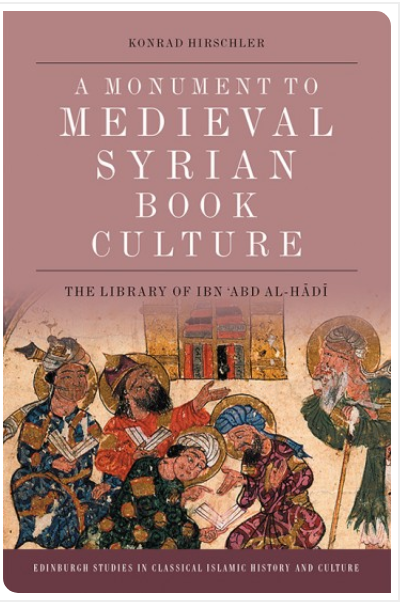
Open Access Book: A Monument to Medieval Syrian Book Culture The Library of Ibn ʿAbd al-Hādī

Author: Konrad Hirschler
Title: A Monument to Medieval Syrian Book Culture The Library of Ibn ʿAbd al-Hādī
Published: Edinburgh Studies in Classical Islamic History and Culture. November 2019
ISBN: 9781474451598 (PDF)

Reassembles the books of a medieval Arabic library that are today dispersed around the world Sets out a new approach to the study of Arabic book culture

Edits the most important Arabic medieval book list
Provides a new angle on the history of ḥadīth in the late-medieval period
Reconceptualises the mobility of endowed books
Reproduces the entire catalogue in colour

In the late medieval period, manuscripts galore circulated in Middle Eastern libraries. Yet very few book collections have come down to us as such or have left a documentary trail. This book discusses the largest private book collection of the pre-Ottoman Arabic Middle East for which we have both a paper trail and a surviving corpus of the manuscripts that once sat on its shelves: the Ibn ʿAbd al-Hādī Library of Damascus. The book suggests that this library was part of the owner’s symbolic strategy to monumentalise a vanishing world of scholarship bound to his life, family, quarter and home city.


Monday, April 8, 2019

Universität Bonn: Translatio digitization project


"Within the framework of a project supported by the Ministry for Innovation, Science and Research of the state of North-Rhine Westphalia (duration 1.11.2013 – 31.10.2014) the Institute for Oriental and Asian Studies of the University of Bonn would like to research how European concepts had been discursively acquired between 1860 and 1945 in Asian and Middle Eastern societies.The aim of the project is to make the very scattered source materials on – to a scientific high degree innovative and for numerous colleagues connectable theme “Translation. The cognitive acquisition of European key concepts in Asian and Middle Eastern societies (1860-1945)” in a first step digital and in one place accessible. Relevant sources from the Middle Eastern and Asian saddle period shall be digitised, exploited and put on the research platform for evaluation and further work from the period 1860-1945: periodicals, lexica, encyclopedias, political publications, remissions and Ego-documents. As periodicals are the basis of the developed public sphere of the aforementioned period, these periodicals form the most important and most extensive primary texts for a conceptual history."

See.

52 titles have been digitized in Arabic, Persian and Ottoman.

Arabic: http://digitale-sammlungen.ulb.uni-bonn.de/topic/titles/3080606

Persian: http://digitale-sammlungen.ulb.uni-bonn.de/topic/titles/3080607

Ottoman: http://digitale-sammlungen.ulb.uni-bonn.de/topic/titles/3085789.


Monday, February 25, 2019

Arabic Collections Online المجموعات العربية على الانترنت

http://dlib.nyu.edu/aco/

UPDATE 2/25/19 : More than 10,000 books now available on Arabic Collections Online,
[Columbia 3411, American University of Beirut 2339, Princeton University Libraries 1354, NYU 1834, The American University in Cairo 361, Cornell 742]

[First posted in AMIR on October 24, 2014, updated March 17 , 2015, August 19, 2015]

UPDATE 8/19/15 : ACO has published new items.
It now has 1009 items [ 407 NYU, 402 Columbia, 200 Cornell.]

UPDATE 3/17/15: ACO published 202 items from the collection of Columbia University Libraries


Monday, April 2, 2018

West African Arabic Manuscript Database

West African Arabic Manuscript Project


[First posted in AMIR 5 May 2012, updated 30 March 2018]
UPDATE: The database platform has been updated. First several thousand digital copies of manuscripts will go on-line this summer [2018]


AMMS is a bi-lingual database that was developed at the University of Illinois in the late 1980s to describe a collection of Arabic manuscripts in southern Mauritania (Boutilimit). It subsequently has been used to catalogue seven other West African collections including the manuscript libraries at the Institut Mauritanien de Recherche Scientifique, Northwestern University, and the Centre Ahmad Baba in Timbuctu.  Currently (during 2011-2) print catalogues from West Africa published by al-Furqan Islamic Heritage Foundation are being added to it. For more information on the activities and publications of the Foundation and these catalogues visit http://www.al-furqan.com
The database has a search engine designed to identify manuscripts and authors when only fragmentary information is available, in Arabic or Roman script, for records now in excess of 23,000. Experimental linkage of digital images of manuscript texts to the records is currently underway.
The database and the AMMS cataloguing tool are publicly available at no cost to users. The AMMS software for cataloging is free and can be downloaded for local use. Thirty-odd fields in Arabic and English cover all the descriptors normally employed in manuscript work and users may customize the input fields for the needs of particular collections. We encourage the inclusion of newly-catalogued material into the main data base; please contact the editors.

إن نظام إدارة المخطوطات العربية ثنائي اللغة-عربي/إنجليزي- المعروف بال AMMS (إختصاراً من الحروف الأولي للبرنامج the Arabic Manuscript Management System) قد تم تطويره من قبل جامعة ألينوي the University of Illinois في الثمانينيات لتوصيف مجموعة من المخطوطات العربية من بوتيلمت بجنوب موريتانيا، و من ثم فقد لََمَت الإستعانة بهذا النظام لفهرسة سبعة مجموعات أخرى من غرب أفريقيا، بما في ذلك المجموعات الخطية لمعهد الأبحاث العلمية بموريتانيا Institut Mauritanien de Recherche Scientifique ، وجامعة نورث وسترن Northwestern University ، و مركز أحمد بابا بتمبكتو. و خلال عامين 2011-2 سيتم إضافة الفهارس المطبوعة التي أصدرتها مؤسسة الفرقان للتراث الإسلامي للنظام. و للإطلاع على المزيد من العلومات عن إصدارات و أنشطة المؤسسة بالإضافة إلي هذه الفهارس يمكن تصفح الموقع الإلكتروني: http://www.al-furqan.com

إن قاعدة معلومات البرنامج قد تم تصميمها خصيصاً لتعيين المخطوطات أو المؤلفين حتى عند وجود معلومات جزئية، سواءً بإستخدام الحروف العربية أو الرومانية، ضمن سجل يربو على 23,000 مدخل. و حالياً، فهناك عمليات تجريبية لربط بعض المخطوطات بنسخها الضوئية.

Friday, March 31, 2017

Arabic Almanac App

Arabic Almanac App
By Omar Jahangir
iPhone Screenshot 1
Description 
Arabic Almanac is a digital version of the famous Hans Wehr dictionary. You can search through the dictionary by using the root letter of the word and the app will display the corresponding page from the Hans Wehr dictionary. This app was developed to aid students of the Arabic Language in their noble pursuit. The app will remove the need of carrying around a bulky dictionary and replace it with the convenience of your smartphone. Now you have access to all the same information, but at the comfort of your fingertips. The dictionary can be searched using an Arabic keyboard, or if you do not have an Arabic keyboard the dictionary can be searched using Roman (English) letters which have an Arabic equivalent. Feel free to add any comments/improvements by emailing arabic.almanac@gmail.com This app could not have been made without the immense contribution from E.Taal and U.Iqbal. I pray that Allah (swt) reward them and their families for their contribution to this app. Please also remember this developer and his family in your duas. ...More Arabic Almanac Support 

What's New in Version 1.3
Salaams all! A few updates for Arabic Almanac. •Removed the “loading” that would appear at the end of the pag
  • Free
  • Category: Education
  • Updated:
  • Version: 1.3
  • Size: 82.6 MB
  • Language: English
  • Seller:
Compatibility: Requires iOS 8.0 or later. Compatible with iPhone, iPad, and iPod touch

Wednesday, February 8, 2017

Ptolemaeus Arabus et Latinus

Ptolemaeus Arabus et Latinus
Project icon: lavishly furnished initial letter with a painting of Ptolemy using an astrolab.
Welcome to the homepage of the project Ptolemaeus Arabus et Latinus (PAL). The website has now been implemented with a beta-version of the database and with samples of transcriptions and images.
The database currently includes the following:
  • Works: 120 entries giving cursory descriptions of Latin Ptolemaic works, that is, works by Ptolemy or attributed to him and commentaries thereupon.
  • Manuscripts: over 250 entries for Latin manuscripts containing Ptolemaic works.  
  • Glossary: nearly 2000 Greek and Arabic technical terms from selected texts (Almagest I-II, Planetary Hypotheses, Planispherium, Tetrabiblos).    
Two Transcriptions are available:
  • Almagest, Latin translation by Gerard of Cremona
  • Almagestum parvum
HD Images of a rapidly increasing number of Ptolemaic works can be accessed through the menu item Reproductions.
Implementation will continue over the coming months and it is anticipated that the alpha-version of the database will be available by the end of 2017. Feedback and comments are welcome at info@ptolemaeus.badw.de.

Tuesday, July 12, 2016

Onomasticon Arabicum (OA)

Onomasticon Arabicum (OA)
logoOa
Onomasticon Arabicum (OA) is a long-living database project. This new online-version informs on more than 15000 scholars and celebrities from the first Muslim millenary. Its entries in Arabic are compiled from ancient biographical dictionaries, a veritable treasure of Islamic culture. Crossed search allows separate interrogation on any of the different elements of the Arabo-Muslim names, dates and places, reconstructing the identity of a person, trace ways of knowledge transmission and frame historical contexts.
يعتبر بنك الأعلام العربي (أونوماستيكون أرابكوم) مشروع قاعدة معطيات طويل المدى. فهو يعرِّف في صيغته الحالية على الانترنت بأكثر من 15000 من علماء وأعلام الألفية الأولى، استخلصت سيرهم من كتب الطبقات والتراجم التي تمثل كنزا أصيلا للثقافة الإسلامية. كما يوفر بحثا متقاطعا يتم من خلاله استجواب مختلف عناصر الاسم العربي-الإسلامي والتواريخ والأماكن استجوابا منفصلا، مما يتيح إعادة بناء هوية الشخص المنشود وتعقب طرق نقل المعرفة مع العناية بالسياقات التاريخية 

Sources of the OA-online

DQ Dumyat al-qaṣr wa-ʻuṣrat ahl al-ʻaṣr
FT Maʻālim al-ʻulamāʼ fī fihrist kutub al-šiʻa wa-asmāʼ al-muṣannifīn minhum qadīman wa-ḥadīthan: tatimmat Kitāb al-fihrist li-l-Shaykh Abī Ğaʿfar al-Ṭūsī
HQ Ḫarīdat al-qaṣr wa-ğarīdat al-ʿaṣr (Damas)
HQ Ḫarīdat al-qaṣr wa-ğarīdat al-ʿaṣr (Irak)
HQ Ḫarīdat al-qaṣr wa-ğarīdat al-ʿaṣr (Maghreb)
IG Ṭabaqāt al-aṭibbā’ wa-l-ḥukamā’
IU Kitāb ʿuyūn al-anbā’ fī ṭabaqāt al-aṭibbā’
MU Kitāb Maʿālim al-‘ulamā’
RN Asmā’ al-Riğāl
SD Šaḏarāt al-ḏahab fī aḫbār man ḏahab
SD1 Šaḏarāt al-ḏahab fī aḫbār man ḏahab
TY Kitāb tatimmat al-Yatīma (mutammim al-aqsām al-ṯāliṯa al-ūlā min al-Yatīma)
UM Nakt al-himyān fī nukat al-ʿumyān
UN Ṭabaqāt al-umam
YT Yatīmat al-dahr fī maḥāsin ahl al-ʿaṣr (volume 4)

Documents


Wednesday, March 2, 2016

Open Acces Journal: Lisanul' Arab: Journal of Arabic Learning and Teaching

Lisanul' Arab: Journal of Arabic Learning and Teaching
p-ISSN: 2252-6269
Page Header
This journal is intended as a medium for scientific discussion, description, and a survey on education, learning, and analysis of Arabic language and literature. Author of the journal is open to all parties who have an interest in education, learning, and analysis of Arabic language and literature. This journal accept articles from the research, conceptual thinking, and book reviews.This journal accepts articles written in Indonesian and Arabic.Publishing twice each year, ie in March and September.


2012


See the Alphabetical List of Open Access Journals in Middle Eastern Studies