Showing posts with label Syriac. Show all posts

Wednesday, March 6, 2024

Syriac Manuscripts in the British Library: A New Digital Edition of Wright’s Catalogue


Syriac Manuscripts in the British Library: A New Digital Edition of Wright’s Catalogue

Editors: David A. Michelson and William L. Potter

"Syriac Manuscripts in the British Library (SMBL) is a digital enhancement of William Wright's Catalogue of Syriac Manuscripts in the British Museum acquired since the year 1838 (London, 1870-1872), published by Syriaca.org: The Syriac Reference Portal in partnership with the British Library as an open access online resource. Using new methods of digital representation, SMBL enables users to engage with the manuscript collection from diverse perspectives, facilitating exploration of the collection according to new and multiple criteria..."

Wednesday, September 28, 2022

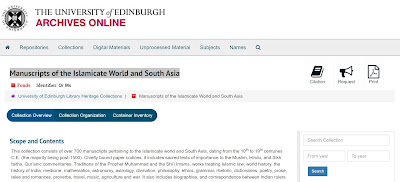
New OA Mss collection: Manuscripts of the Islamicate World and South Asia, University of Edinburgh


"Scope and Contents

This collection consists of over 700 manuscripts pertaining to the Islamicate world and South Asia, dating from the 10th to 19th centuries C.E. (the majority being post-1500). Chiefly bound paper codices, it includes sacred texts of importance to the Muslim, Hindu, and Sikh faiths, Qur’anic commentaries, Traditions of the Prophet Muhammad and the Shi’i Imams, works treating Islamic law, world history, the history of India, medicine, mathematics, astronomy, astrology, divination, philosophy, ethics, grammar, rhetoric, dictionaries, poetry, prose, tales and romances, proverbs, travel, music, agriculture and war. It also includes biographies, and correspondence between Indian rulers and dignitaries, and East India Company officials. 

Some of the collection’s manuscripts are among the most iconic items found at the University of Edinburgh Library, such as Qur’anic fragments in Kufic script on vellum, dating to around the 10th century (Os Ms 175), Rashīd al-Dīn’s Jamī al-Tawārīkh (Or Ms 20) and al-Bīrūnī's al-Āthār al-bāqiya (Or Ms 161), both richly illuminated examples of Islamic historiography dating to the 14th century C.E., and an 18th century Sanskrit scroll of the Hindu Mahābhārata featuring miniature illuminations and measuring over 70 metres (Or Ms 510). 

The grouping together of these items as one collection is the legacy of the route by which they reached the Library. It includes the vast majority of items formerly known as the "Oriental Collection"; the large donations that formed its basis were from the collections assembled by employees of the East India Company. This resulted in the collection incorporating material relevant to the Islamicate, largely gathered in South Asia, intertwined with items relevant to the Hindu and Sikh faiths, and the culture and history of South Asia more generally. The Turkish component of the collection includes manuscripts acquired in Astrakhan, with several early Ottoman texts. The items retain their "Or Ms" shelf mark to avoid creating a gap in the memory of their history. All catalogue records include the available provenance data. Research in this area is ongoing and such information will be expanded to include all details attesting the route of these items into the University of Edinburgh’s collections. 

Dates: 10th-19th centuries C.E. (bulk: post-1500 C.E.)

Language of Materials
Mainly in Persian and Arabic, but also Turkish, Sanskrit, Bengali, Hindustani, Malay, Panjabi, Prakrit, Syriac and Urdu.

Conditions Governing Access
Open. Please contact the repository in advance.
Extent

30 linear metres (approx)"

Manuscripts of the Islamicate World and South Asia: URL: https://archives.collections.ed.ac.uk/repositories/2/resources/86063 

Tuesday, September 15, 2015

The Syriac Gazetteer

The Syriac Gazetteer
http://syriaca.org/resources/img/map3.png
The Syriac Gazetteer is a geographical reference work of Syriaca.org for places relevant to Syriac studies. “Places relevant to Syriac Studies” include places named in Syriac texts (such as Ḥarqel — ܚܪܩܠ), places interesting to historians who work on Syriac texts (such as Dura-Europos), and places where scholarship on Syriac is being produced (such as Japan). There are no temporal or spatial boundaries for the geographic database, which collects places relevant to any period of history useful for Syriac studies, from places mentioned in the Peshitta version of Genesis to places founded recently, and from ancient Edessa to Mongol-era outposts in China and diaspora communities in the United States of America. At least in theory, any type or size of place could be represented in the geographic database, from large empires to single churches or a particular named city gate. Maps are provided for places whose location is known, but the database includes places which are not located or even locatable: each place is a conceptual thing with a mental existence related to, but not reducible to, its physical manifestation. Mythological and other ahistorical places are also included in the database.
  • Index page: an alphabetic index of places in the gazetteer.
  • About page: an overview of the gazetteer and its contributors.
  • Help page: documentation, editorial guidelines, and technical definitions.
  • Browse maps: browse places on an interactive map.
  • Edessa: featured place.