Showing posts with label Photography. Show all posts

Tuesday, March 15, 2022

Crafts of Iraq


"The Crafts of Iraq site contains information about craft activities in cities, towns, and rural areas across Iraq, drawn from primary texts, archaeological and ethnographic publications, historical photographs, online sources, and signatures on objects, buildings and manuscripts. Entries cover a period from the seventh century to the present day. The site also comprises a glossary of technical terms, timeline, and other research supports..."

Project of Dr Marcus Milwright, Professor of Islamic Art and Archaeology, University of Victoria, Canada.

See also: Crafts of Syria


Thursday, July 8, 2021

OA Book: Imaging and Imagining Palestine: Photography, Modernity and the Biblical Lens, 1918–1948


Imaging and Imagining Palestine

Photography, Modernity and the Biblical Lens, 1918–1948

Series: Open Jerusalem, Volume: 3
Editors: Karène Sanchez Summerer and Sary Zananiri

Imaging and Imagining Palestine is the first comprehensive study of photography during the British Mandate period (1918–1948). It addresses well-known archives, photos from private collections never available before and archives that have until recently remained closed. This interdisciplinary volume argues that photography is central to a different understanding of the social and political complexities of Palestine in this period.

While Biblical and Orientalist images abound, the chapters in this book go further by questioning the impact of photography on the social histories of British Mandate Palestine. This book considers the specific archives, the work of individual photographers, methods for reading historical photography from the present and how we might begin the process of decolonising photography.

"Imaging and Imagining Palestine presents a timely and much-needed critical evaluation of the role of photography in Palestine. Drawing together leading interdisciplinary specialists and engaging a range of innovative methodologies, the volume makes clear the ways in which photography reflects the shifting political, cultural and economic landscape of the British Mandate period, and experiences of modernity in Palestine. Actively problematising conventional understandings of production, circulation and the in/stability of the photographic document, Imaging and Imagining Palestineprovides essential reading for decolonial studies of photography and visual culture studies of Palestine." - Chrisoula Lionis, author of Laughter in Occupied Palestine: Comedy and Identity in Art and Film

"Imaging and Imagining Palestine is the first and much needed overview of photography during the British Mandate period. From well-known and accessible photographic archives to private family albums, it deals with the cultural and political relations of the period thinking about both the Western perceptions of Palestine as well as its modern social life. This book brings together an impressive array of material and analyses to form an interdisciplinary perspective that considers just how photography shapes our understanding of the past as well as the ways in which the past might be reclaimed." - Jack Persekian, Founding Director of Al Ma'mal Foundation for Contemporary Art in Jerusalem

"Imaging and Imagining Palestine draws together a plethora of fresh approaches to the field of photography in Palestine. It considers Palestine as a central node in global photographic production and the ways in which photography shaped the modern imaging and imagining from within a fresh regional theoretical perspective." - Salwa Mikdadi, Director al Mawrid Arab Center for the Study of Art, New York University Abu Dhabi 

Copyright Year: 2021

E-Book (PDF)

Availability: Published ISBN: 978-90-04-43794-4Publication Date: 05 Jul 2021

Imaging and Imagining Palestine: https://brill.com/view/title/55370 


Thursday, June 24, 2021

OA Resource: AzKataloq


"Azərbaycanın tarixi foto və sənədlər kataloqu. Sayt GlobalSoft şirkətinin dəstəyi ilə hazırlanıb"

A catalogue of historical photos and documents of Azerbaijan. 

Azkataloq: https://azkataloq.org/ 

Tuesday, January 19, 2021

Digital Catalogue of a Photographic Archive of Cairo - The Photographs of Beniamino Facchinelli (1839-1895)

Open Access Digital Catalogue of a Photographic Archive of Cairo - The Photographs of Beniamino Facchinelli (1839-1895)

"I am pleased to release of the digital catalogue of views of Cairo's monumental heritage taken by Italian photographer Beniamino Facchinelli (1839-1895) after his settling in 1875 in the Egyptian capital, where he died twenty years later. The catalogue currently features 726 high-definition reproductions of images identified among the holdings of six libraries and museums across the globe; it is designed to incorporate further ones as they appear in collections willing to share their content in full Open Access mode. 

It is estimated that Facchinelli produced about 1200 topographical views during his stay in Egypt, of which 900 have been already listed and located, though not all copyright-cleared yet. All images are authenticated through cross-referencing, and their original captions are listed in the entries, as well as the albums and publications where they were reproduced. The whole represents a unique documentation on buildings which have either disappeared since then, or been radically transformed in course of restoration; it also includes rare views on their furnishings. Because the photographs of the reconstructed corpus were often commissioned by dedicated preservationists and inserted in their publications (although without any credit to their author), one can closely follow through them how a vanishing architectural, visual and material culture was then viewed, valued and defended."

[Mercedes Volait  - CNRS Research Professor at InVisu
https://invisu.cnrs.fr/  via H-Islamart ]


Friday, October 18, 2019

Open Access Archive - Digital Palestinian Archive


Digital Palestinian Archive

"The Birzeit University Digital Palestinian Archive (BZUDPA) is dedicated to documenting the life of Palestinians and their institutions over the past century, from Ottoman times to the present.The project, launched in 2011, aims to preserve a large variety of documents, written and audio-visual, relating to the history of the Palestinian people over the past century, and donated by individuals, families and popular organizations. Birzeit, as a national university, is fully committed to placing its technical and academic resources at the service of this project, which continually digitizes, places online and makes available a wide variety of documents. "

Wednesday, September 4, 2019

A Guide to Online Visual Sources in Middle East, North Africa, and Islamic Studies


A Guide to Online Visual Sources in Middle East, North Africa, and Islamic Studies by Amanda Hannoosh Steinberg the Visual Resources Librarian for Islamic Art & Architecture at the Harvard Fine Arts Library.

"Let’s face it: every publication is better with images. Whether it’s a presentation, a blog post, a book, or just a paper, images engage an audience instantly. The internet is flush with images from Islamic art, architecture, and society, but reliable sources (with credit information) are more difficult to track down. So we’ve done it for you! Here are some of the best sites for finding credited visual resources for Islamic, Middle Eastern and North African Studies. Feel free to suggest more in the comments and we’ll update the list!...
see more 

Monday, June 3, 2019

Arab Image Foundation


Arab Image Foundation
[Update:  June 3, 2019 :
"Arab photography archive releases 22,000 historic images online
Arab Image Foundation completes $255,000 digitisation initiative and will reopen its Beirut building this summer"]
The Arab Image Foundation is a non-profit organization established in Beirut in 1997. Its mission is to collect, preserve and study photographs from the Middle East, North Africa and the Arab diaspora. 
The AIF’s expanding collection is generated through artist and scholar-led projects. The Foundation makes its collection accessible to the public through a wide spectrum of activities, including exhibitions, publications, videos, a website and an online image database.  
 The ongoing research and acquisition of photographs include so far Lebanon, Syria, Palestine, Jordan, Egypt, Morocco, Iraq, Iran, Mexico, Argentina and Senegal. To date, the collection holds more than 600,000 photographs.

Thursday, July 5, 2018

Akkasah, the Center for Photography at New York University Abu Dhabi

http://akkasah.org/

"Akkasah, the Center for Photography at New York University Abu Dhabi, is home to an archive of the photographic heritage of the Middle East and North Africa. The Center is dedicated to documenting and preserving the diverse histories and practices of photography from the region, and our growing archive contains at present over 60,000 images"

Browse By:

Monday, June 12, 2017

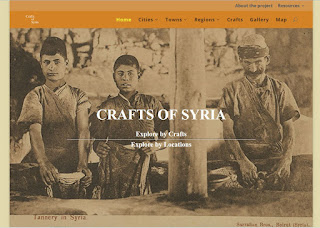
Crafts of Syria

http://craftsofsyria.uvic.ca/


Crafts of Syria

"... Many of the monuments and archaeological sites have been looted, with some deliberately destroyed during the conflict. The crafts are another significant component of the rich cultural heritage of Syria, and this site is intended to preserve information on aspects of traditional manufacturing practices of urban and rural areas. It is hoped that this will be a resource for students and researchers working on the material cultures and socio-economic life of Syria and the surrounding regions of the Middle East.
This site is organized according to the cities, towns, and other settlements of modern Syria. Within each of these you will find primary written sources, secondary historical studies, ethnographic and archaeological research, and photographs that provide evidence for craft activities conducted in these locations across Syria from the seventh century to the present. The site will also be complemented by a range of resources designed to aid in the study of the craft traditions of this region. Some are already available on the site, and others will be added soon. These comprise: essays dealing with specific aspects of the crafts of Islamic Syria, links to related archives and collections, maps, short biographies of major primary sources, a glossary of technical terms, and a bibliography."

Thursday, April 6, 2017

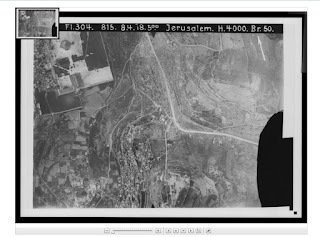
The Bavarian Air Force World War I Aerial Photography of Palestine = Bayerisches Hauptstaatsarchiv: Bildsammlung Palästina

http://www.gda-old.bayern.de/findmittel/ead/index.php?fb=478

 
The Bavarian Air Force World War I Aerial Photography of Palestine = Bayerisches Hauptstaatsarchiv: Bildsammlung Palästina

"The 2,872 photographs, comprising both aerial and ground photographs that are
now available on the website of the Central State Archive of the Bavarian State Office
for Surveying, constitute an important resource for the study of many aspects of the
landscape of Palestine and other territories at the end of Ottoman rule in the region.
These photographs offer an overview of the region’s topography as it was almost one
hundred years ago, and as such are of great significance to geographers, historians, and
researchers working on urban cultural history "

See also: Mapping Palestine: The Bavarian Air Force WWI Aerial Photography

Tuesday, May 20, 2014

Manar Al-Athar منار الآثار: Free multi-media resource for the study of the Middle East

Manar Al-Athar منار الآثار: Free multi-media resource for the study of the Middle East
The Manar al-Athar website, based at the University of Oxford, aims to provide high resolution, searchable images for teaching, research, and publication. These images of archaeological sites, with buildings and art, will cover the areas of the former Roman empire which later came under Islamic rule, such as Syro-Palestine/the Levant, Arabia, Egypt, North Africa and Spain. The chronological range is from Alexander the Great (i.e., from about 300 BC) through, the Islamic period to the present. It is the first website of its kind providing such material labelled jointly in both Arabic and English. We will also be publishing related material, both online and on paper, in English and Arabic.
كلمة ترحيبية
يهدف موقع منار الآثار الإلكتروني، التابع لجامعة أكسفورد، إلى تزويدكم بصور عالية الجودة للغايات العلمية والتعليمية والبحثية؛ إذ تحتوي الصور على نماذج معمارية وفنية لمواقع أثرية كانت ضمن مناطق الإمبراطورية الرومانية السابقة والتي وقعت لاحقاً تحت الحكم الإسلامي: مثل بلاد الشام وبعض أجزاء الجزيرة العربية ومصر وشمال أفريقيا وأسبانيا. تمتد الفترة الزمنية لهذه المواقع الأثرية من أيام الإسكندر المقدوني (حوالي 300 قبل الميلاد) والفترة الإسلامية إلى الوقت الحاضر. يعد موقع منار الآثار الإلكتروني الأول من نوعه الذي يزود روّاده بمواد معنونة باللغتين العربية والإنجليزية معاً. فضلاً عن ذلك سيتم نشر مواد ذات صلة بالموضوع على الموقع الإلكتروني و بشكل ورقي باللغتين الإنجليزية والعربية
Manar al-Athar is Arabic for "Guide to Archaeology" and has been chosen because Manara, in Egypt, refers to both the Lighthouse of Alexandria (the Pharos) and to minarets. This conveys the transition, and often continuity, covered by the chronological range of the material.
قمنا بتسمية هذا الموقع بـ منار الآثار ليكون مصدراً علمياً لدراسي علم الآثار والحضارات القديمة؛ نسبةً الى منارة الاسكندرية في مصر، ونتمنى أن نكون قد وفقنا باختيار الاسم المناسب لهذا الموقع 

Tuesday, December 17, 2013

UNRWA audiovisual archive for Palestine refugees


http://archive.unrwa.org/license/home/unrwa.do

UNRWA audiovisual archive for Palestine refugees

"The United Nations Relief and Works Agency (UNRWA) is proud to unveil the first part of its newly digitized archive, which consists of over half a million negatives, prints, slides, films and videocassettes covering all aspects of the life and history of Palestine refugees from 1948 to the present day.
The first group of iconic photographs and films are part of an exhibition, ‘The Long Journey’, which opens on 28 November at the Al-Ma’mal Centre in the Old City of Jerusalem. The archive was inscribed on the UNESCO ‘Memory of the World’ register, which includes collections of outstanding cultural and historical significance."

Friday, April 19, 2013

Freer/Sackler: Iran in Photograph

Iran in Photographs
The art of photography was introduced to Iran more than 150 years ago. Browse this site to view hundreds of photographs taken in the late nineteenth and early twentieth century, from distinguished images of the Qajar royal family and expansive views of Persepolis to glimpses of everyday in life on the streets of Tehran. Explore the use of glass-plate negatives in early photography, research archival records, learn about collectors, and take an intimate look at life in Iran a century ago.

The Archives of the Freer Gallery of Art and Arthur M. Sackler Gallery contain more than 1,100 original prints and glass-plate negatives by Antonin Sevruguin and other photographers. A grant from the Parsa Foundation funded the digitization and cataloging of the entire Freer and Sackler collection, the largest public collection of Sevruguin’s photographs outside of Iran. These prints and plates, assembled from the donated holdings of avid collectors and historians, form the core of a rapidly growing collection of early photography of Iran and establish the Freer and Sackler Archives as a leading center for its study.

If you have individual images or albums of photographs taken in Iran and other Near Eastern countries before 1950, please consider donating them to the Freer and Sackler Archives. Contact 202.633.0533 or AVRreference@si.edu for more information.


Wednesday, February 20, 2013

Orientalist Photography

Orientalist Photography
The collection includes late nineteenth century and early twentieth century architecture in
Arab cityscapes and natural landscapes. The photos bear witness to the scars left by the
Ottoman empire , French and English. The collection includes postcards and albumen
photographs. The majority of the albumen photos where taken by professional
photographers, including the Zangaki brothers, Pascal Sabah and Lehnert & Landrock.


Orientalist photography (and painting) was born out of the westerners' desire for
entertainment and amusement. It capitalizes on portraying Arabs as savages in staged
settings. One section of the collection, the Colonial Harem postcards, is a testimony to this
notion. The Colonial Harem postcards were created primarily by French photographers.
The models for these postcards were very young girls from north Africa, primarily Morocco
, Alger, Tunis, and Egypt .. The photographs were staged to duplicate the compositions
of the western orientalist painters, embedding the false conception of the uncivilized Arab
even deeper in the western psyche.


The stereo-topical photographs of the Palestinian people and their lifestyle were created
to target western Christians, many of whom never traveled from their homes but were
curious about the birth place of Jesus.

Tuesday, February 19, 2013

Sirat Bani Hilal Digital Archive


 Sirat Bani Hilal Digital Archive
"The Sirat Bani Hilal Digital Archive is designed as an open access resource for the preservation and dissemination of audio recordings, written texts, photographic images and other materials related to the “Epic of the Bani Hilal tribe” (Arabic: Sīrat Banī Hilāl سيرة بني هلال ). The site is dedicated to the epic singers of al-Bakātūsh (Egypt) for their willingness to share their knowledge and performances of this thousand-year-old epic poem."
The Archive was created and is maintained with support of the American Council of Learned Societies and the University of California, Santa Barbara.

Friday, October 12, 2012

Das Bild des Orients

Das Bild des Orients: Bilagentur für Islamische Kunst
  http://www.das-bild-des-orients.de/imgs/signet.gif
Das Bild des Orients stellt Agenturen, Verlagen, wissenschaftlichen Institutionen und privaten Nutzern Bildmaterial zum islamischen, christlichen und Alten Orient in seiner Vielfalt zur Verfügung. Dabei sollen wissenschaftliche Interessen (Bildarchiv) und eine kommerzielle Nutzung (Bildagentur) miteinander verbunden werden.

Verstärkt wird auch historisches Bildmaterial zum Orient präsentiert. Aufgrund der großen Veränderungen im Orient kann man als "historisch" schon Bilder aus den 1960er Jahren (und älter) bezeichnen. Sie finden interessante Aufnahmen, u.a. aus der Türkei und dem Jemen, aufgenommen von dem
Geologen Dr. Erich-Holm von Prosch, der u.a. in den 1950er Jahren auf Einladung Imam Ahmads (reg. 1948-62) im Jemen nach Erdöl gesucht hat. Aus seiner Sammlung stammen auch einige Aufnahmen, die Imam Ahmad bei seinem Besuch in Sanaa zeigen, u.a. mit dem saudischen König Saud b. Abd al-Aziz (1954).

Zu den Highlights gehören eine Aufnahme des deutschen Kaisers
Wilhelm II. zusammen mit dem osmanischen Sultan Mehmed V. in der offenen Kutsche bei der Fahrt durch Konstantinopel (1917) oder die Gesamtansicht des Yildiz Saray mit der Hamidiye Moschee aus dem berühmten Photostudio Sebah & Joaillier in Konstantinopel.

Außerdem wird ausgesuchtes "Fremdmaterial" zugänglich gemacht, wie z.B. Photos aus dem Nachlass
Johann Gottfried Wetzstein (1815 - 1905) der Stiftung Wetzstein, die in der Staatsbibliothek zu Berlin

The image archive "Das Bild des Orients" offers a wide range of photographic material of the Islamic (Christian and Ancient) Orient to agencies, publishing houses and scholarly institutions as well to private users. Selling images is the basic to be able to run, enlarge and enhance the archive.

More and more historical photographs are also presented on the website. Due to the dramatic changes the Orient underwent since the 1960s, the label "historical" is given to images which are older than 40 years (in 2005). See e.g. the unknown photos and slides from Turkey and Yemen taken in the 1950s by the German geologist
Dr. Erich-Holm von Prosch, one of the first oil explorers in Yemen, invited by Imam Ahmad (ruling 1948-62). From his collection comes a photo showing Imam Ahmad in Sanaa on occasion of the visit of the Saudi Arab king Saud b. Abd al-Aziz (in 1954) .

To the highlights belong images showing the
German emperor Wilhelm II. together with the Ottoman Sultan Mehmed V. in the open coach in Constantinople in 1917 or the general view of the Yildiz Saray with the Hamidiye mosque from the famous photo studio Sebah & Joaillier in Constantinople.

We will also present more selected photographic material from other institutions, such as the unusual photos from the estate of
Johann Gottfried Wetzstein (1815 - 1905) in the Wetzstein foundation, kept in the Staatsbibliothek zu Berlin.

 Bildersuche   Erweiterte Suche 
Leuchtkasten

Tuesday, August 28, 2012

Alexandria Bombardment of 1882 Photograph Album

Alexandria Bombardment of 1882 Photograph Album
http://digitalcollections.aucegypt.edu/utils/getthumbnail/collection/p15795coll9/id/117
The Alexandria Bombardment of 1882 Photograph Album digital collection was originally compiled by Italian photographer Luigi Fiorillo. This unique resource documents the British naval attack on 'Urabi Pasha's nationalists, who revolted against Taufik Pasha, the Khedive of Egypt, from 1879 to 1882. Fiorillo’s fifty page album records damage to Alexandria's neighborhoods, particularly the harbor and the fortress district. The images trace the development of episode from the arrival of the British fleet to the destruction of the emerging downtown district. Further, the photographs show the artillery and forts used by the resistance. The album also features portraits of the key players in the bombardment, including 'Urabi Pasha, Khedive Taufik, Admiral Seymour, and Sir Wolseley.

Fiorillo was active from the 1870s to the 1890s. Although his main studio was located in Alexandria, he is known to have traveled widely throughout Egypt and Africa. He is best known for this distinctive album
.

Monday, May 21, 2012

The Architectural Heritage of the Ottoman Balkans - Machiel Kiel photographic archive


 "In September 2011 the Netherlands Institute in Turkey (NIT) has launched a project for the digitization and publication of the photographic archive of Machiel Kiel. A former director of the NIT, Kiel is a renowned Dutch scholar intrinsically connected with the study of Ottoman architectural monuments in the Balkan countries, which he pioneered. His archive represents an invaluable source for researchers of this heritage. Created for the most part between the 1960s and 90s, it also contains visual documentation of many monuments that have not survived, or have been significantly altered in, the second half of the twentieth century.
The publication of Kiel’s archive by the NIT is hoped to significantly advance international research on this heritage.    
In May, 2012, the NIT made available online the almost 1300 images digitized and processed within phase 1 of the project, pertaining to Ottoman-Islamic architectural monuments in the Southeast-European countries (outside Turkey).
During phase 2 will be processed these images of monuments in Turkish Thrace; during phase 3, Christian monuments and mural painting from the Ottoman period will follow. The NIT will successively make available this material to the public.
For further information, please contact the coordinator of the project, Dr. Maximilian Hartmuth, at kielarchive@nit-istanbul.org"

Saturday, May 12, 2012

Historical Photographs of the Land of Israel

Historical Photographs of the Land of Israel: Younes & Soraya Nazarian Library, University of Haifa

The Land of Israel has always attracted professional and amateur photographers. Over the years, archives, institutions and individuals have kept rare collections, documenting its unique views and people. The university's library operates for the digital conservation and documentation of these contents, in order to keep them from wearing out and to provide accessibility for education and research purposes.

In the website are photographs from various sources that were donated to the library's Digital Media Center.

The digital collection is part of the work done by the library of Haifa University. Its purpose is to expose and provide accessibility to historical photographs of the Land of Israel. The project started as cooperation with the department of Land of Israel Studies in Haifa University and Bitmuna project.

The library staff scans and catalogues the photographs. Identification of documented locations, people and events is done with the help of collection owners, information received from users, and the kind help of Mr. Kanisberg, Ronnie.

The website allows access to the library's photographs collections according to theme, contributor or geography. It also allows access to the Digital Media Center's search options, where you can search freely for various materials.

All the photographs in the Historical Photographs of the Land of Israel website are available to the public, under fair use and copyright limitations.


Wednesday, May 9, 2012

The Creswell Archive Online

Ashmolean Museum of Art and Archaeology: The Creswell Archive
In 1975 the Department of Eastern Art of the Ashmolean Museum was fortunate enough to receive a bequest consisting of the unique negative collection of Professor K.A.C. Creswell, the eminent pioneer of medieval Islamic architectural history. Among the photographs are many of those used to illustrate the two publications which remain the basic research tools for scholars of medieval Islamic architecture: Creswell's Early Muslim Architecture, and Muslim Architecture of Egypt. 
The collection also includes large number of photographs intended for a third volume of Muslim Architecture of Egypt, which was to deal with the monuments of the Burji Mamluk period. Since this project remained unfinished at the time of Creswell's death, the bulk of these are unpublished.
Over the past decade the Ashmolean Museum has undertaken the printing, identification and digitisation of the Creswell Archive with the aim of making this exceptional collection available to a wider audience.

The subjects of the photographs range in place and date from al-Andalus to Iraq, from the late seventh century to the eighteenth. The greater part of the archive consists of images of the architecture of Egypt and the Levant between the twelfth and fifteenth centuries. Most were taken in the second quarter of this century.

Some of the buildings which Creswell photographed are no longer extant, others subsequently underwent drastic, and often poorly-documented campaignes of restoration. The photographs therefore provide an invaluable record for those interested in the history of the major monuments of the Islamic Middle East.

In addition, links are provided to the Fine Arts Library, Harvard University, which holds a collection of 2,706 Creswell prints now available online, via ArchNet, the website established at the Massachusetts Institute of Technology in co-ordination with the Aga Khan Program for Islamic Architecture.
Biography | Bibliography | Browse | Search | Acknowledgements | Copyright and Print Orders | Feedback