Friday, February 16, 2018

Open Access Journal: Annales Islamologiques

Annales Islamologiques
ISSN électronique: 2429-2850
 
Les Annales islamologiques sont une revue pluridisciplinaire annuelle, publiant en français, anglais et arabe, des études originales dans tous les domaines relatifs à l’Égypte et au monde arabo-musulman, du VIIe siècle à nos jours : histoire, histoire de l’art, archéologie, conservation et restauration, linguistique, littérature, droit, religion, histoire des sciences, ethnologie. Chaque numéro comprend un dossier thématique et des varia.

NUMÉROS EN TEXTE INTÉGRAL

Earlier volumes (open access through  volume 46) are available directly from the IFAO:
1 2 3 4 5 6 7 8 9 10 11 12 13 14 15 16 17 18 19 20 21 22 23 24 25 26 26.2 27 28 29 30 31 32 33 34 35 36 37 38 39 40 
41 42 43 44 45 46 47 48.1 48.2 49 50

Exhibition: ROMANCE AND REASON: Islamic Transformations of the Classical Past

ROMANCE AND REASON: Islamic Transformations of the Classical Past
KhamsaFolios 50 verso, 51 recto: Iskandar Served Kay Khusraw’s Magical Goblet (jam-i jahan-bin)Author: Nizami Ganjavi (1141–1209); Copyist: Unknown; Language: PersianInk, opaque watercolor, and gold on paperIndia, 17th century, illustrations possibly laterFrom the collections of The National Library of Israel: Ms. Yah. Ar. 1021Image (c) National Library of Israel 
The story of antiquity reads as an endless cycle of expansion, conflict, and conquest. Yet despite the divisions that existed among peoples and nations, the exchange and appropriation of ideas, images, and heroic figures across cultures knew no boundaries, with the Classical World retaining a particular appeal across countries and beliefs.

Thursday, February 15, 2018

Open Access Archive: Egyptian Press Archive of CEDEJ


http://cedej.bibalex.org/

Egyptian Press Archive of CEDEJ
Presented online by the Bibliotheca Alexandrina 

"The CEDEJ and the Bibliotheca Alexandrina are pleased to present, through the digitization of more than 800,000 articles in Arabic, English and French, 40 years of Egyptian political, cultural and economic life - from the mid-1970s until 2010...


Since the year 1976, the CEDEJ formed a documentary collection of 800,000 articles from the principal organs of the Egyptian press and classified according to 15 thematic areas, which are divided into themes and sub-themes. The CEDEJ catalogued and indexed the archives, preparing the material for online dissemination.

The BA, as a leader in the digitization of Arabic text, designed and implemented a proficient workflow for digitizing this valuable collection using state-of-the-art technology, while applying digitization best practices in the production of a user friendly website encompassing the whole collection. Moreover, the BA has implemented convenient browsing facilities and search functionalities to allow easy access to the material available.

This work was carried out from 24 Egyptian and Arabic newspapers - daily and weekly - including 13 print and 11 digital media. Through these scanned articles, we can follow the evolution of swathes of contemporary Egyptian society'"

Wednesday, February 14, 2018

Landscapes and monuments: Iran to Spain

Landscapes and monuments: Iran to Spain
Landscapes and monuments


Garth Fowden is a historian of first millennium CE Eurasia, who in pursuit of his interests has travelled extensively in the Mediterranean, the Middle East and North Africa. For the greater part of his career he has lived and worked in Greece. This site presents a digitized version of the photographic archive he developed while conducting research on the landscapes and monuments of these regions.
Fowden was born in Norwich in 1953. He first visited the Middle East - Lebanon and Jordan, especially Jerusalem - in 1966 when his father was working in Beirut. After completing his secondary education he spent a year (1970-71) in the employ of the Anglican Archbishop in Jerusalem, George Appleton. A few photographs survive from this early experience of the landscapes, archaeology and religious life of Jerusalem and Palestine. In 1971 Fowden embarked on his undergraduate and then doctoral studies at Merton College, Oxford. From 1978 to 1983 he was a research fellow at Peterhouse and subsequently at Darwin College, Cambridge. He briefly taught Byzantine and Modern Greek History at Groningen, and in 1986 moved to a research position specializing in the Greek East at the Centre for Greek and Roman Antiquity, National Hellenic Research Foundation, Athens. In 2013 he became the first holder of the Sultan Qaboos Chair of Abrahamic Faiths in the University of Cambridge. The social aspect of intellectual and religious life in late Antiquity has been a permanent focus of his books and articles, but always informed by his interest in the material culture, archaeology, art and epigraphy of the eastern Mediterranean and the Middle East, especially Athens, Lycia, Constantinople, Greater Syria and Egypt. More recently, the rise of Islam in relation to the ancient cultures and empires of Iran and Rome has become the main focus of his work. All these concerns are documented and illuminated in the archive here presented.
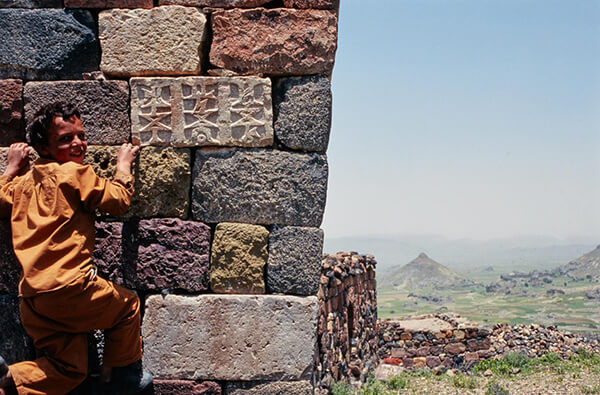
From 1977 Fowden began to travel systematically in the Middle East including Turkey, but photography did not become a priority until 1986. The latest items in the archive date from 2007. The main regions covered are Greece, Turkey, Syria, Jordan, Iran and Yemen, and less extensively Spain, Italy, Lebanon, Palestine and Egypt. The strengths of the collection, reflecting Fowden's research and teaching interests at different periods, are:  - the relationship between settlement and landscape;  - fortification, and the evolution of the urban tissue, especially in the late Roman period;  - religious architecture, especially the conversion of holy places, monasticism, and the emergence of Islam;  - art and epigraphy preserved in architectural or archaeological contexts; - traditional  domestic architecture. 
Within each site, the photographs are arranged in a sequence designed to convey some sense of a physical visit, sometimes starting and/or ending with more general shots of the surrounding landscape and of the routes that traverse it. Photographs taken on site are occasionally supplemented by items from museums or print publications designed to make the collection more suitable for teaching purposes.
The documentation of Palmyra, Aleppo (where Fowden spent the first half of 1996 as the guest of the Syrian Orthodox Archbishop Mar Gregorios Yohanna Ibrahim), and the Yemen, has particular value and poignancy in the light of recent events. Even more than war, though, it has been urbanization, the construction of dams, and the extensive irrigation of formerly arid areas, that has transformed the region in recent decades. Many of the places recorded will be inaccessible to foreign visitors for the foreseeable future, and are anyway changed beyond recognition.

Thursday, February 1, 2018

Open Access Journal: Journal of the General Union of Arab Archaeologists - مجلة اتحاد الأثریین العرب

Journal of the General Union of Arab Archaeologists - مجلة اتحاد الأثریین العرب
Print ISSN: 2537-026X
Online ISSN: 2537-0278
Journal of the General Union of Arab Archaeologists
Journal of the General Union of Arab Archaeologists is an annual academic journal that publishes specialized research and studies in the fields of archeology, museums, restoration and Arab national civilizations, published by the General Union of Arab Archaeologists and the Union of Arab Universities since 2000 to date. It publishes research studies in several languages: Arabic, English, French and German and has an international and regional refereeing committee. Due to the success achieved by the Journal of the General Union of Arab Archaeologists, the Editorial Department considered the publication of a new issue of the Journal in foreign languages, in order to raise the level of academic research of Arab archaeologists at the international level. There is no doubt that the Journal of the General Union of Arab Archaeologists is the result of an archeological academic interaction and movement not only in Egypt but among all archaeologists in the Arab world from the ocean to the Gulf. This profound academic product of subjects is not confined to academic publishing, but is a crucible for academic and practical rapprochement between the archaeologists, in a sincere attempt to find a language that is mutually enriching, without programming or preconditions. Therefore, this convergence succeeded in unifying the archeological term among archaeologists, in which each researcher presented his research in a smooth simple language and a term rolling away from the regional terminology so that each researcher does not write for himself, but writes in a language of dialogue that is comprehended by all Arab archaeologists, whether in the East or Morocco. Thus, the Journal of the General Union of Arab Archaeologists managed to reach an academic vision and a common research language that was accepted by many researchers, especially in the field of terminology. In turn, with the commencement of the new issue of the Union Journal in foreign languages, we look forward to keeping up with international publication standards, for the Journal of the General Union of Arab Archaeologists has obtained the ISI (International Accreditation),the journal has Impact factor of 0.589 based on international citation report ( ICR) for the year 2016- 2017  anticipating to reach the desired objectives.
Journal Archive
Volume Volume 2 (2017)
1

Publishing and studying of a group of stirrups preserved in the Gayer-Anderson Museum in Cairo With its comparison with models from paintings of the ottoman manuscripts


Page 1-27


2

IAt The Milk Goddess in Ancient Egyptian Theology


Page 28-56

Ayman Mohamed Ahmed Mohamed


3

A Door Lintel with Cartouches at the Egyptian Museum (JE.59895)


Page 57-66

Bassem Mohamed Sayed Ahmed


4

L’Art rupestre de l’atlas saharien (Algérie) Essai d’analyse spatiale


Page 67-85

Merouane Rabhi; Hocine Bellahreche


5

Unpublished late period statue, Cairo Museum JE. 36978


Page 38-56

Eman Ahmed Abouzaid


6

Xkr (Kheker) frieze in ancient Egypt


Page 85-111

Naglaa Fathy Ahmed Shehab

Volume Volume 1 (2016)
Earlier issues, entirely in Arabic, appear online under the title مجلة اتحاد الأثریین العرب
[ISSN: 2536-9822 (Print); 2536-9830 (Online)]

Open Access Journal: Babylon: Nordisk tidsskrift for Midtøstenstudier

Babylon: Nordisk tidsskrift for Midtøstenstudier
ISSN: 2535-3098
Page Header
Babylon – Nordisk tidsskrift for Midtøstenstudier er Nordens ledende vitenskapelige tidsskrift om samtidens Midtøsten. Tidsskriftet publiserer akademiske artikler, bokessay og anmeldelser innenfor fagfeltet. Bidragene er i hovedsak skrevet pÃ¥ skandinaviske sprÃ¥k, men Babylon trykker i utvalgte tilfeller engelsksprÃ¥klige bidrag fra ikke-skandinaviske forfattere.

Babylon leses av forskere, studenter, journalister og andre som arbeider med, eller er interessert i, Midtøsten. Babylon er representert i de fleste av landets ledende fag- og institusjonsbibliotek. Tidsskriftet distribueres også via privat abonnement og ledende bokhandlere.


2004

2003


No 1 (2003): Hvorfor ikke demokrati i Midtøsten?