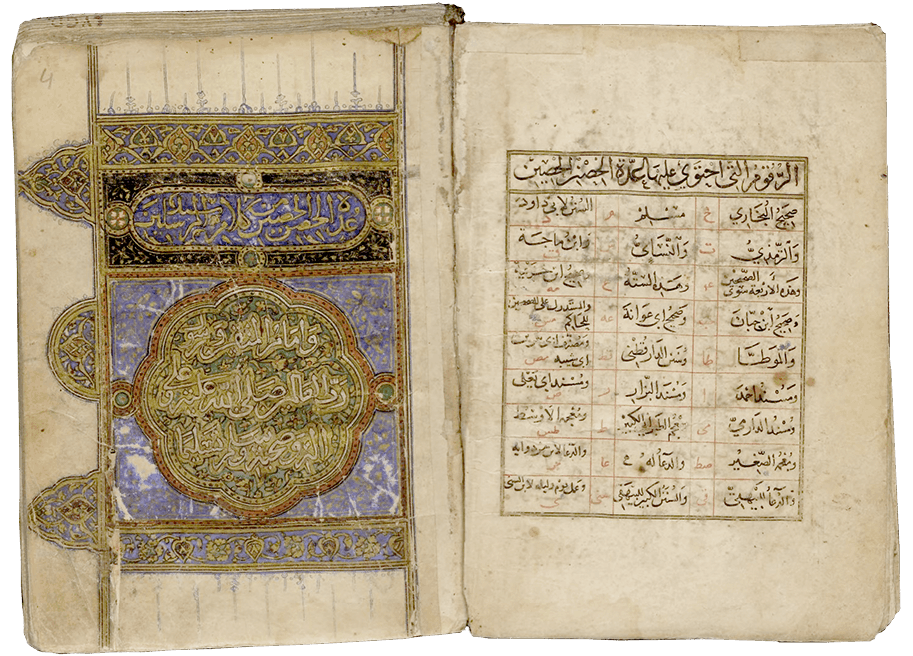
This is a collection of lessons in codicology – the study of handwritten documents or codices - and palaeography from the Muslim world. The lessons will guide you through the ways books were made and used there before the printing press, by investigating the traces left by producers, owners and readers of manuscripts. Using your mouse, you will come close to people in the manuscript age as they produced, transmitted, cherished and “consumed” the written texts.
The lessons are centered around fully digitalised manuscripts from the oriental collection of Leiden University Libraries. They include samples in Arabic, Persian and Coptic, from cultures ranging from the Maghrib to Mughal India. The lessons can be read in any order. All include suggestions for further reading and questions (with answers) or assignments.
Lessons
Papyrus fragment – of what?
Lesson 1 Papyrus was made exclusively in Egypt, where the papyrus plant grows. But it was used thr...
Arabic before print: dots, vowels and hamzas
Lesson 2 Thanks to the endeavours of early Arabic grammarians, the written Arabic language was larg...
Quires and quire signatures
Lesson 3 A codex is produced by binding together a number of quires (pl. karārīs, sg kurrās). Quire...
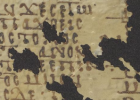
Parchment and recollection (Coptic)
Lesson 4 Parchment was used as a carrier for text in the eastern Mediterranean region since Antiqu...
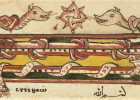
Perfect compilation (Coptic)
Lesson 5 Many skills were needed to make a book of exceptional quality. The parchment or paper had ...
"Mouvance" or a fair draft
Lesson 6 The words kāna al-farāgh min bayḍa (or mubayyaḍa) in a colophon are usually translated as...
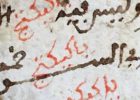
Damage and protection
Lesson 7 Books are vulnerable. Most codices are made of paper, which is light and flexible, but al...
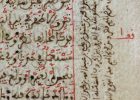
Lecture marks in a legal manual
Lesson 8 In the manuscript age, writers and readers had to develop particular techniques to make th...
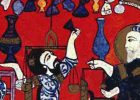
Engagement notes in a pharmacist's manual
Lesson 9 In the Arabic tradition, owners (and even borrowers) of codices often added notes not onl...
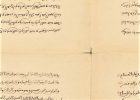
Imposition: writing on undivided quadrifolia
Lesson 10 Once in a while, you will come across an old printed book in which the pages still need to...
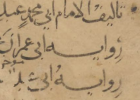
Transmission
Lesson 11 In the first centuries of Islam, the transmission of knowledge was predominantly oral. Kno...
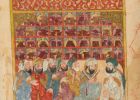
The Oral Book
Lesson 12 Early hadith scholars were skeptical of books. They cherished the oral origins of their di...
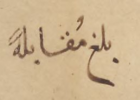
Collation
Lesson 13 The physical production of a new copy of a book in the Manuscript Age could occur in sever...
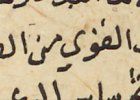
Manuscript variations and scribal errors
Lesson 14 From amongst the hundreds of thousands of Arabic manuscripts surviving today, only very f...
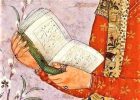
Ownership notes in imperial Mughal codices
Lesson 15 Notes of ownership or tamalluk, often on the flyleaf of a codex, show us in the first plac...
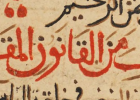
The trajectory of "The Canon of Medicine"
Lesson 16 In manuscript cultures textual knowledge was transmitted over centuries by the copying lab...
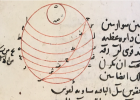
Notes on astronomy
Lesson 17 Astronomy in the Arabic world has a long history of study, and so it is not uncommon for m...
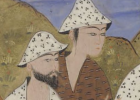
Authenticity and the Shāhnāma (Persian)
Lesson 18 The Shāhnāma or Book of Kings by Manṣūr Abū al-Qāsim Firdawsī Ṭūsī narrates the legendary ...
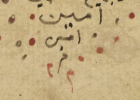
Colophon
Lesson 19 Colophon is our word for the information written down by a scribe or copyist in the Arabi...
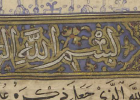
Arabic script and iconography
Lesson 20 The relationship between Muslim-world artists and the depiction of animate beings is well...
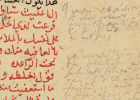
European readers of Arabic manuscripts
Lesson 21 As compact, readily-movable objects, books can have wide-ranging, itinerant lives. And gi...
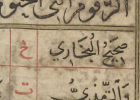
Manuscript quotation practices
Lesson 22 Pre-modern Arabic writing was particularly attuned to issues of authenticity. Perhaps it ...
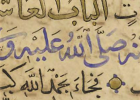
A portable book of prayer
Lesson 23 The lessons of this online course are meant as an introduction to “the real thing”. One o...
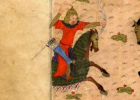
Illustration in the Shāhnāma tradition (Persian)
Lesson 24 The Shāhnāma or Book of Kings by Manṣūr Abū al-Qāsim Firdawsī Ṭūsī narrates the legendary ...
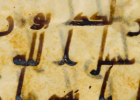
HIJAZI - Palaeography EXERCISE
Lesson 50 ‘Ḥijāzī script’ is a script style used for the oldest Arabic texts preserved. Despite its ...
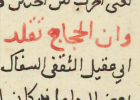
NASKH - Palaeography EXERCISE
Lesson 51 Naskh literally means ‘copying’; the related noun nāsikh (or nassākh) connotes a ‘copyist’...
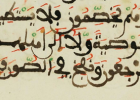
MAGHRIBI - Palaeography EXERCISE
Lesson 52 The Maghribi script has developed from the Kufic script, or more precisely from the formal...
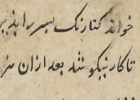
NASTA'LIQ Palaeography EXERCISE
Lesson 53 The term nastaʿlīq is a contraction of two terms for calligraphic styles in Persian writin...
Following soon
Lesson 54 Read more...
Thursday, February 4, 2021
Lessons in codicology and palaeographybased on manuscripts from the Middle East, Islamic Africa and beyond

Sunday, January 31, 2021
eShia Digital Library

eShia Library is a large digital library of religious, historical and legal texts focused primarily on Shia Islam. It contains over six thousand titles with information and extracts from quite recent or contemporary scholars and theologians which may not be seen elsewhere.
Individual titles have have been transcribed not digitized but a random check on few titles seem to indicate that the publication and edition information is retained. Download is limited to 30 pages only.
Wednesday, January 27, 2021
Open Access Digital Library - al-Hakawati - Digital Public Library of Arab and Islamic Culture
Digital Public Library of Arab and Islamic Culture
[First posted Dec 19, 2010, updated Jan 27, 2021]
Published : [Beirut, Lebanon?] : Arab Cultural Trust
ISSN: 2379-7290
Arabic and English versions available.
al-Hakawati is the Arabic word for storyteller. The website is a free educational resource and reference made possible by the Arab Cultural Trust. The content is arranged thematically in ten sections, each with several subsections. New entries are regularly added to the website.
Topics include: stories & tales, personalities, states, cities & regions, civilizations, arts & artists, histories & culture, environment, architecture and religion.

Monday, January 25, 2021
Digital Ottoman Studies

"Digital Humanities is a new field that grows rapidly in the academic environment. This website is designed as a hub for digital projects, tools, events, publications, and platforms to contribute to Digital Humanities from the perspective of Ottoman and Turkish Studies. The 600-year-old Ottoman Empire's archival heritage, spanning diverse ethnic and geographical regions, holds high potential for digital humanities. This website aims to create a digital network for future projects by bringing together studies, people, and institutions. "
Tuesday, January 19, 2021
Iraq Heritage Stabilization Program
The Iraq Heritage Stabilization Program (IHSP) is a project-oriented initiative dedicated to supporting Iraqi communities affected by conflict and cultural cleansing and empowering Iraqi heritage professionals to protect and preserve Iraq’s rich cultural heritage. Established in 2018, IHSP has implemented more than ten projects to assess, stabilize, and restore heritage in northern and central Iraq through the support of public and private institutions. IHSP is based in the University of Pennsylvania’s Department of Near Eastern Languages and Civilizations.
Digital Catalogue of a Photographic Archive of Cairo - The Photographs of Beniamino Facchinelli (1839-1895)

Open Access Digital Catalogue of a Photographic Archive of Cairo - The Photographs of Beniamino Facchinelli (1839-1895)
"I am pleased to release of the digital catalogue of views of Cairo's monumental heritage taken by Italian photographer Beniamino Facchinelli (1839-1895) after his settling in 1875 in the Egyptian capital, where he died twenty years later. The catalogue currently features 726 high-definition reproductions of images identified among the holdings of six libraries and museums across the globe; it is designed to incorporate further ones as they appear in collections willing to share their content in full Open Access mode.
It is estimated that Facchinelli produced about 1200 topographical views during his stay in Egypt, of which 900 have been already listed and located, though not all copyright-cleared yet. All images are authenticated through cross-referencing, and their original captions are listed in the entries, as well as the albums and publications where they were reproduced. The whole represents a unique documentation on buildings which have either disappeared since then, or been radically transformed in course of restoration; it also includes rare views on their furnishings. Because the photographs of the reconstructed corpus were often commissioned by dedicated preservationists and inserted in their publications (although without any credit to their author), one can closely follow through them how a vanishing architectural, visual and material culture was then viewed, valued and defended."
[Mercedes Volait - CNRS Research Professor at InVisu
https://invisu.cnrs.fr/ via H-Islamart ]
Thursday, January 14, 2021
Open Access Journal Archive: العربى = al-ʻArabī (1958-1973, 1985-1990)

al-ʻArabī = العربى
Published: [Kuwayt] : [publisher not identified], 1958-
Editor: Editor: Ahmad Zakī
ISSN: 0258-3941
Other titles:
Alaraby : Fabr-ayir 1963-Aghustus 1973
Arabi : Ukt-ubir 1980-
Alarabi : Sibtambir 1973-Sibtambir 1980
ʻArabī