Keshif: E-Journal for Ottoman-Turkish Micro Editions
Published: The Institute for Near Eastern Studies, University of Vienna, 2023-
ISSN: 2960-4311
Vol. 1 No. 1 (2023)
See also : Alphabetical List of Open Access Journals in Middle Eastern Studies
Keshif: E-Journal for Ottoman-Turkish Micro Editions
Published: The Institute for Near Eastern Studies, University of Vienna, 2023-
ISSN: 2960-4311
Vol. 1 No. 1 (2023)
See also : Alphabetical List of Open Access Journals in Middle Eastern Studies
The aim with the present series, The Quran: Key Word Distribution, Correlations and Collocation Frequencies, is to present key data related to the lexicon of the Quran, in terms of Key Word distribution and lexical associations. The digital text used for this purpose is the Uthmani text of the Tanzil Quran Text. This text is widely used. All vocalized Arabic text is quoted unaltered in any shape or form from the Tanzil text. Unvocalized Arabic text and transcriptions are my own. In this series, each Key Word, here adjectives, nouns, proper nouns and verbs, is presented together with the following key data: Degree of Concentration, Weighted Distribution, Correlations and Collocation Frequencies. The Key Words are always referenced by their lemma and are sorted alphabetically according to Arabic and UNICODE order. In lemmatizing the words, no attention has been given to the semantics of each word. Only on rare occasion have similar forms of words or proper nouns been separated in order to avoid confusion. In assigning each word a lemma, Classical dictionaries and Quran commentaries, as well as modern Quran dictionaries have been consulted. Deciding on these is not always obvious, since classical dictionaries and commentaries sometimes either disagree or present divergent variant readings or root and lemma attributions. It is our hope and aim that this series contributes to Computational Linguistics and Digital Humanities in general, and Computational Linguistics research on the Quran in particular.
Publisher: Gorgias Press LLCSKU (ISBN): 978-1-4632-4414-9
Series: Gorgias Islamic Studies 16Publication Date: Feb 23,2022Interior Color: BlackTrim Size: 6 x 9Page Count: 516Languages: Arabic, EnglishISBN: 978-1-4632-4414-9
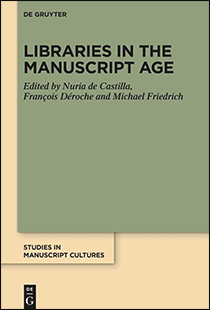
Contributors: Luciano Bossina, Nuria de Castilla, Gérard Colas, Jean-Pierre Drège, François Déroche, Michael Friedrich, Vanina Kopp, Donatella Nebbiai
ISBN: 9783110779653
Author: Pradines, Stéphane
Title: Muslim Cultures of the Indian Ocean : Diversity and Pluralism Past and Present.
Published: Edinburgh: Edinburgh University Press; 2023.
ISBN: 9781474486521
Summary:
"Scholars are increasingly recognising the centrality of the Indian Ocean in the study of Muslim cultures.
This volume explores the expanding and changing roles of these Muslim communities across the Indian Ocean World from the seventh century to the mediaeval period to the present day. The book goes beyond the usual focus on geographical sub-regions to highlight different aspects of interconnectivity in relation to Islam. By analysing textual and material evidence, the fifteen papers in this volume examine identities and diasporas, manuscripts and literature, as well as vernacular and religious architecture. It explores the networks and movements of peoples, ideas and ideologies, as well as art, culture, religion and heritage."
The Foundation, established in 2010, made the following available online :
al-Hilal issues (1892-2007), Major Articles, Complete Novels.
Investigates the relationship between culture, politics and power in present-day Turkey, from headscarves to heavy metal
- Provides an overview of the politics of culture in Turkey under the rule of the AKP
- Analyses the success of authoritarian populism and the decline of democracy in Turkey from a cultural studies perspective
- Brings together 16 empirical studies that explore cultural aspects from heavy metal music to arthouse films, and from headscarf politics to national memory
Since coming to power, President Erdoğan’s Justice and Development Party (AKP) have focused on narrating their vision of a ‘New Turkey’ – an ideal that has resulted in the politicisation of popular culture and people’s everyday lives. Exposing the strategy of Turkey’s ruling elite to obtain cultural hegemony, this book examines the AKP’s efforts to rewrite Turkish public memory by promoting its ideas through TV series, movies, propaganda videos, school curricula and material culture in urban public spaces. It also explores the tactics of cultural resistance developed by the politically weak to counter the ruling elite’s dominant culture of pious conservatism.
- 234 mm x 156mm
- 368 pages
- Edinburgh Studies on Modern Turkey
- Published August 2023 (Paperback)
- Published November 2021 (Hardback)
- ISBN
- Paperback: 9781474490290
- Hardback: 9781474490283
- Ebook (ePub): 9781474490306
- Ebook (PDF): 9781474490313
Foreword
Martin Stokes, King’s College London1. The Politics of Culture in ‘New Turkey’
Pierre Hecker, Ivo Furman, Kaya AkyıldızPart I: Subcultures and the Politics of Lifestyles
2. Battling Over the Spirit of a Nation: Attitudes Towards Alcohol in ‘New Turkey’
Ivo Furman, Istanbul Bilgi University3. Spreading VX-Gas over Kaaba: Islamic Semiotics in Turkish Black Metal
Douglas Mattsson, Södertörn University Stockholm4. Tired of Religion: Atheism and Non-Belief in ‘New Turkey’
Pierre Hecker, Philipps University MarburgPart II: Satire and Agitprop in ‘New Turkey’
5. Democra-Z: Election Ads, a Failed Coup and Zombie Politics in ‘New Turkey’
Josh Carney, American University of Beirut6. United against the Referee: Competitive Authoritarianism, Soccer and the Remaking of Nationalism in Erdoğanist Turkey
Can Evren, Duke University7. Between Resistance and Surrender: Counter-hegemonic Discourses in Turkish Satirical Magazines
Valentina Marcella, University of NaplesPart III: Civil Society and the Politics of Gender
8. The Boundaries of Womanhood in ‘New Turkey’: The Case of KADEM
Gülşen Çakıl-Dinçer, Adıyaman University9. Never Walk Alone: The Politics of Unveiling in ‘New Turkey’
Ayşe Çavdar, Philipps University Marburg10. Welcome to Dystopia. A View into the Counter-hegemonic Discourse(s) of Ecological Activism in Istanbul
Julia Lazarus, BerlinPART IV: Mediating Neo-Ottomanism in Popular Culture
11. New Histories for a New Turkey: The First Battle of Kut (1916) and the Reshaping of the Ottoman Past
Burak Onaran, Mimar Sinan Güzel Sanatlar University12. Between Invention and Authenticity: Representations of Abdülhamid II in the TV Series ‘Payitaht’
Caner Tekin, Ruhr University Bochum13. Writing a Visual History of Turkey: ‘Glorious History’ in Mainstream Cinema vs ‘Complicated History’ in Arthouse Films
Diliara Brileva A. Krymsky, Institute of Oriental Studies, Ukraine14. The Politics of Nostalgia: The New Urban Culture in Ankara’s Historic Neighbourhoods
Petek Onur, University of CopenhagenPART V: ‘New Turkey’s’ Ethno-Religious Others
15. The Affirmation of Sunni Supremacism in Erdoğan’s ‘New Turkey’
Kaya Akyıldız, Istanbul Bahçeşehir University16. ‘Because They Would Misunderstand’: Romeyka Heritage and the Masculine Reconfigurations of Public Culture in Contemporary Turkey
Erol Sağlam, Istanbul Medeniyet University17. A Politics of Presence: Public Performances of Roma Belonging in Istanbul
Danielle V. Schoon, Ohio State UniversityNotes on Contributors
Index
Examines how the Kurdish diaspora in Denmark supported the Kurdish struggle in Syria from the battle of Kobane (2014) to the defeat in Afrin (2018)
- Investigates how the Kurdish diaspora mobilised in support of Syrian Kurds, stressing the role of transnational actors in war
- Introduces strategic interactionism into the study of diaspora mobilisation, showing new paths for research
- Coins the term ‘alter-territorial’ identification to clarify how some Kurds identify with the political entity in a part of Kurdistan other than their place of origin
Anne Sofie Schøtt contributes to our understanding of mobilisation and identity formation in the periphery of the Kurdish diaspora by examining the small but well-established community in Denmark. Arguing that the Danish authorities treat the diaspora differently in comparison to neighbouring Sweden and Germany, Schøtt examines the political lobbyism, the courtroom activism and the humanitarian action of the various Kurdish diaspora groups. She examines the position of the Syrian Kurds within the diaspora who, like the Kurds in Syria, have been largely ignored until recently.
Schøtt also provides new knowledge on diaspora engagement in war in the homeland by analysing the strategic interaction between the Danish authorities and the Kurdish diaspora community – both engaged in the war against Islamic State, but on different terms.
Part I: Kurdish Diaspora Mobilisation and Identity Formation
1. Introduction
2. Conceptual and Theoretical Framework
3. Methodology and Fieldwork
Part II: The Emergence of Kurdish Activists in Syria and In Denmark
4. The Kurds of Syria: From the Forgotten People to World-Stage Actors
5. The Becoming of A Diaspora: The Kurds and Kurdish Activists In Denmark
Part III: Ambiguous Interplays
6. The Castle and the Square: Political Lobbyism
7. The Courtroom: Legal Struggle for Military Support
8. The Suburb and the Field: Charity Work
Part IV: Findings and Conclusions
9. Ambiguous Interplays and Reformulations of Kurdish Identities
Appendix
References.
- 234 mm x 156mm
- 280 pages
- Edinburgh Studies on Diasporas and Transnationalism
- Published August 2023 (Paperback)
- Published October 2021 (Hardback)
- ISBN
- Paperback: 9781474491716
- Hardback: 9781474491709
- Ebook (ePub): 9781474491723
- Ebook (PDF): 9781474491730