"The Persian Grammar Guide is a free online resource for Persian language learners.
The grammar guides have been created with the aid and resources available at San Diego State University’s Language Acquisition Resource Center (LARC) in order to allow Persian language learners the opportunity to build on their learning experience through an interactive, comprehensive, and self-paced online resource, filled with descriptions, examples, audio, and activities.
You can click through the Alphabet to learn the names and sounds of each letter in the Persian alphabet, then try your hand at spelling some of the basic words introduced throughout the project.
The rest of the grammar section is divided into parts of speech. These are comprehensive grammar guides that are meant to aid Persian learners by explaining the rules of the language. They are not lessons in themselves but resources to refer to in order to understand Persian language structure. Each of these sections will include descriptions of the parts of speech in English, as well as the names for them in Persian. You will also look through examples and get the chance to practice what you are learning."
Thursday, November 6, 2014
Persian Grammar Guide
Wednesday, November 5, 2014
Brill's most downloaded articles from Q3 2014 in the subject area of Middle East & Islamic Studies -- Free access until 31 January 2015
"These articles are freely available until 31 January 2015!*
Author: Aharon Layish
Islamic Law and Society, (Volume 21, No. 3, pp. 276-307)
Author: Aria Nakissa
Islamic Law and Society, (Volume 21, No. 3, pp. 209-251)
Author: Maaike van Berkel
Journal of Abbasid Studies, (Volume 1, No. 1, pp. 7-22)
Author: Christopher Melchert
Journal of Abbasid Studies, (Volume 1, No. 1, pp. 23-45)
Author: Stijn Aerts
Journal of Abbasid Studies, (Volume 1, No. 1, pp. 66-83)
Author: Khadiga Musa
Islamic Law and Society, (Volume 21, No. 4, pp. 419 – 452)
Author: Stephen J. Shoemaker
Arabica, (Volume 61, No. 5, pp. 514-558)
Author: Lloyd Ridgeon
Journal of Sufi Studies, (Volume 1, No. 1, pp. 3-30) (free sample issue)
Authors: Behnam Sadeghi and Uwe Bergmann
Arabica, (Volume 57, No. 4, pp. 343-436)
Author: Hideyuki Ioh
Arabica, (Volume 61, No. 5, pp. 471-513)
Author: Andrew Rippin
Al-Bayan: Journal of Qur'an and Hadith Studies, (Volume 11, No. 2, pp. 1-14)
(Open Access)
(Open Access)
Author: Nadje Al-Ali
Middle East Journal of Culture and Communication,
(Volume 5, No. 1, pp. 26-31)
Author: Michael Cooperson
Journal of Abbasid Studies, (Volume 1, No. 1, pp. 4-6)
Author: Pernilla Myrne
Journal of Abbasid Studies, (Volume 1, No. 1, pp. 46-65)
Author: Khalil al-Anani
Sociology of Islam, (Volume 1, No. 1-2, pp. 41-63) (free sample issue)
* Articles in Open Access and in free sample issues remain freely available after this date."
Friday, October 24, 2014
Corpus Inscriptionum Crucesignatorum Terrae Sanctae: Anthology of Crusader Inscriptions in the Holy Land (1099-1291)
Corpus Inscriptionum Crucesignatorum Terrae Sanctae
Anthology of Crusader Inscriptions in the Holy Land (1099-1291)
Sabino De Sandoli, OFM
Anthology of Crusader Inscriptions in the Holy Land (1099-1291)
Sabino De Sandoli, OFM
Father Sabino De Sandoli's "Corpus Inscriptionum" is the most extensive collection of surviving Crusader inscriptions ever published. The inscriptions, written between 1099 and 1291, have been collected from all areas of Palestine: from Gaza to Acre, from Hebron to Banias, and from the southern part of Transjordan.
"Corpus Inscriptionum Crucesignatorum Terrae Sanctae" was published in 1973 by Studium Biblicum Franciscanum and the Franciscan Printing Press in Jerusalem.
Since 1333, when the Custody of the Holy Land was established, the Franciscan Friars have made an enormous contribution to the Crusader epigraphy. With pious dedication, they have diligently recorded the ultimate expression of the profound religiousness of their heroic predecessors.
The English translation was performed by Michael Olteanu.
Cover Pages Prefazione - Preface Indice generale - General Index Indice Bibliografico - Bibliographic Index
Introduzione - Introduction Fonti e studi - Sources and Studies Classifica delle Iscrizioni Crociati - Classification of the Crusader Inscriptions La Paleografia Crociata - The Crusader Paleography La Lingua Latina nell'Epigrafia Crociata - The Latin Language in the Crusader Epigraphy La Religiosità dei crociati - The Religiousness of the Crusaders Il Regno di Gerusalemme - The Kingdom of Jerusalem
Il Demanio Reale di Gerusalemme - The Royal State of Jerusalem
Gerusalemme - JerusalemI Parte: Iscrizioni Crociate dentro le Mura - Part I: Crusader Inscriptions within the City Walls La Basilica del Santo Sepolcro - The Basilica of the Holy Sepulchre
L'Ospedale di San Giovanni - The Hospital of Saint John
Il Tempio del Signore - The Temple of the Lord
Iscrizioni di altri luoghi dentro le mura di Gerusalemme - Inscriptions at other sites within the walls of Jerusalem
II Parte: Iscrizioni Crociate fuori le Mura - Part II: Crusader Inscriptions outside the City Walls La chiesa di San Stefano - The church of Saint Stephen
Il Monte Sion - Mount Zion
I Santuari della Valle di Giosafat - The Sanctuaries of the Valley of Josaphat
Il Monte degli Olivi - The Mount of Olives
Betlemme - Bethlehem Betlemme - Bethlehem
Altre località del Demanio Reale di Gerusalemme - Other Sites in the Royal State of Jerusalem Altre località a Nord e Ovest di Gerusalemme - Other Sites North and West of Jerusalem
III Parte: Le Signorie Crociate della Palestina - Part III: The Crusader Seignories of Palestine La Signoria di San Abramo (Ebron), d'Oltre-Giordano, la Contea di Giaffa e Ascalone, la Signoria di Blanche-Garde, Ramleh e Lidda, Arsuf, Nàblus, Rafidia e Sebaste, Cesareea Maritima, Caifa - The Seignory of St. Abraham (Hebron), Transjordan, the County of Jaffa and Ascalon, the Seignory of Blanche Garde, Ramleh and Lidda, Arsuf, Nàblus, Rafidia and Sebaste, Cesarea, Caifa La Signoria del Archivescovo di Nazaret, il Castello di Belvoir, L'Abbazia del Monte Tabor, il Principato di Tiberiade, il Castello di Safad, la Signoria di Bànias - The Seignory of the Archbishop of Nazareth,the Castle of Belvoir, the Abbey of Mount Tabor, the Principality of Tiberiade, the Castle of Safad, the Seignory of Bànias San Giovanni d'Acri - Saint John of Acre Appendice - Appendix Errata - Errata Indice delle Illustrazioni - Illustrations Index Indice Linguistico - Linguistic Index Indice Analitico - Analytic Index Back Cover
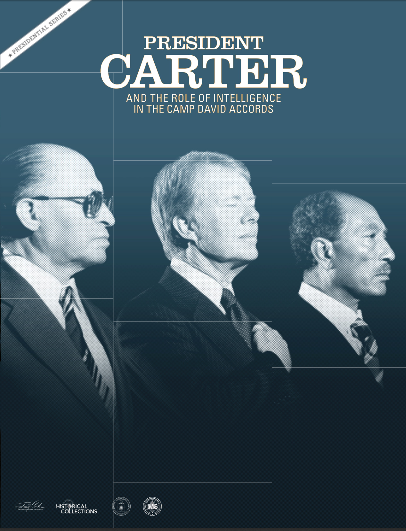
President Carter and the Role of Intelligence in the Camp David Accords
"This collection consists of more than 250 previously classified documents, totaling over 1,400 pages, including some 150 that are being released for the first time. These documents cover the period from January 1977 through March 1979 and were produced by the CIA to support the Carter administration’s diplomatic efforts leading up to President Carter’s negotiations with Egyptian President Anwar Sadat and Israeli Prime Minister Menachem Begin at Camp David in September 1978. The declassified documents detail diplomatic developments from the Arab peace offensive and President Sadat’s trip to Jerusalem through the regionwide aftermath of Camp David. Newly released items include:
Two National Intelligence Estimates on Egypt and the Middle East Military Balance.
Selections from CIA’s briefing book on Camp David created for President Carter.
Leadership profiles from the Directorate of Intelligence on the key personalities of the Camp David summit.
Intelligence on informal and formal inter-Arab negotiations and divisions between Israeli political parties with regard to the peace initiative and summit.
The role of Jordan in the peace process
Over four hundred pages of Foreign Broadcast Information Service reporting, capturing the press coverage of the negotiations, summit, and global reaction."
Thursday, October 23, 2014
Qatar Digital Library
What is the Qatar Digital Library?
The Qatar Digital Library (QDL) is making a vast archive featuring the cultural and historical heritage of the Gulf and wider region freely available online for the first time. It includes archives, maps, manuscripts, sound recordings, photographs and much more, complete with contextualised explanatory notes and links, in both English and Arabic.
How did the QDL come about?
The QDL has been developed as part of a 10-year Memorandum of Understanding on Partnerships between the Qatar Foundation, the Qatar National Library and The British Library. The website was developed by the Partnership in collaboration with Cogapp. The agreement of work for the first phase of the Partnership began in 2012, with the digitisation of a wide range of content from the British Library’s collections. Find out more about the Partnership.
Filter by document source:
- (-) Remove Items in the archive filter Items in the archive
Filter by subject:
Filter by place:
Filter by type:
Filter by people & organisations:
Wednesday, October 22, 2014
Database of Southeast Asian Islamic Manuscripts (D'SAIN)
Database of Southeast Asian Islamic Manuscripts
Catalog of Southeast Asian Islamic Manuscripts published by Faculty of Adab and Humanities, Syarif Hidayatullah State Islamic University Jakarta.
"Database of Nusantara Islam Manuscripts is a database that provides various informations related to Nusantara Islam manuscripts. The database covers a wide range of Nusantara Islam manuscripts-based research—using philological approach or other approaches; conducting by foreign scholars or native scholars. As the center of Nusantara Islam manuscripts, the database not only records the title, author, copyist, language, and literacy texts, but also provides a number of manuscript collections and catalogues including lists, and various publications relating to manuscript which is used as the primary resource of research. In addition, the database provides authors and copyists’ biographical information and their activities. Therefore, Database of Nusantara Islam Manuscripts, as the center of information and research on manuscript that can be accessed online, is very important for the manuscripts-based researches and other researches. Thus, through the information contained in the database of Nusantara Islam manuscript, various topics of research can be developed further, while the potential for duplication and plagiarism cases in the study of manuscript can also be avoided."
Friday, October 17, 2014
Open Access Bibliography: A researchers’ list and bibliography of Ottoman travel accounts to Europe
A researchers’ list and bibliography of Ottoman travel accounts to Europe
Hillebrand, Caspar,
(2nd edition)
Bonn, September 2014
ISSN 2196-9620
Hillebrand, Caspar,
(2nd edition)
Bonn, September 2014
ISSN 2196-9620
Subscribe to:
Posts (Atom)